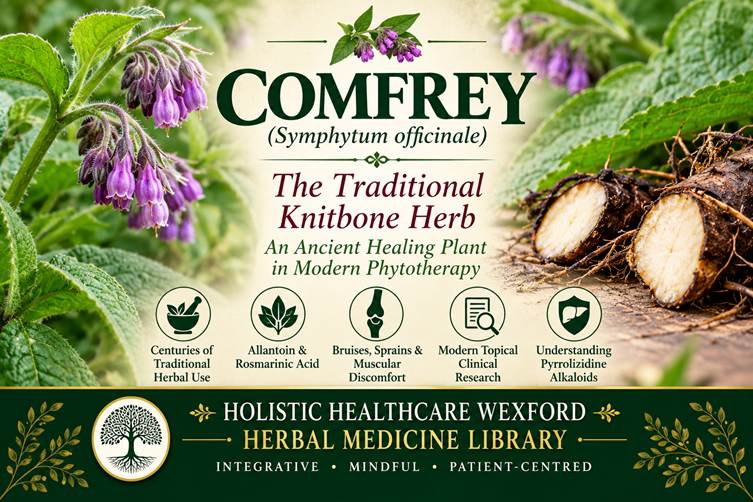
Part of the Holistic Healthcare Wexford Herbal Medicine Library
By Dr Catherine W. Dunne, MSc.D., RGN (GPN), M.H.I.T., I.R.E.T.
Introduction
Some medicinal plants become famous for their fragrance. Others for their beautiful flowers, culinary qualities or remarkable ability to thrive in the most inhospitable places.
Comfrey earned its reputation for something rather different.
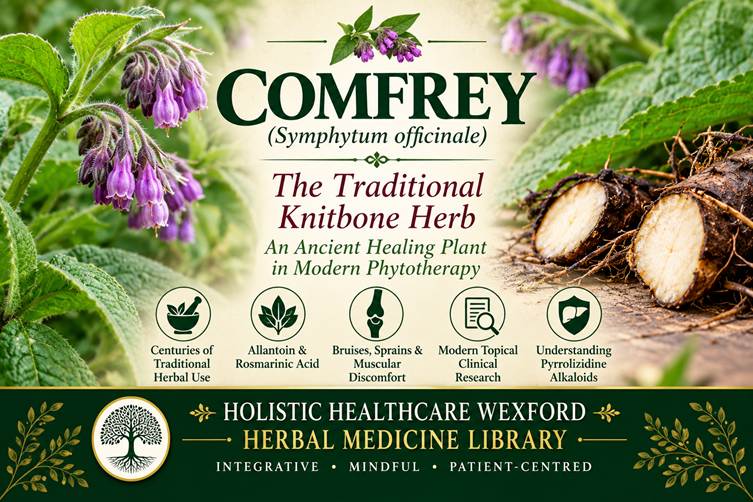
For centuries, this unassuming perennial, with its broad, hairy leaves and delicate bell-shaped flowers, was associated with the healing of injured tissues. Its traditional names, Knitbone and Boneset, reflect the extraordinary confidence that generations of European herbalists placed in the plant.
Long before the discovery of allantoin, rosmarinic acid or the complex chemistry of pyrrolizidine alkaloids, comfrey had established itself as a familiar presence in monastery gardens, rural households and traditional herbal medicine.
Its thick, dark roots, pale and slippery when freshly cut, were traditionally crushed into poultices and applied over bruises, sprains and swollen joints. Its large leaves were gathered throughout the growing season, while the plant itself became known for its remarkable persistence and ability to regenerate from fragments of root left in the soil.
In Germany, comfrey is known as Beinwell, a name deeply connected with its historical association with the healing of bones and limbs. Across Britain and Ireland, the name Knitbone carried much the same meaning.
Yet the story of comfrey is considerably more complex than its traditional reputation might suggest.
Modern scientific research has identified several biologically active constituents and investigated the effectiveness of standardised topical comfrey preparations for musculoskeletal discomfort. Clinical studies have reported encouraging findings in conditions such as ankle sprains, acute back pain and osteoarthritis-related symptoms.
At the same time, advances in toxicology have revealed that comfrey contains naturally occurring pyrrolizidine alkaloids, some of which are capable of causing serious liver injury and possess genotoxic potential.
These discoveries have changed how comfrey is assessed and used in contemporary herbal medicine.
Today, the plant occupies an interesting position between historical tradition and modern pharmacological understanding. Its medicinal potential has not disappeared, but responsible use requires a much clearer distinction between traditional homemade preparations and carefully manufactured topical products.
For the herbalist, comfrey offers a fascinating opportunity to explore the relationship between plant chemistry, traditional observations and modern clinical evidence.
And for the gardener, it offers another lesson entirely.
Despite its reputation for vigorous growth and persistence, comfrey does not always establish itself as readily as the gardening books might suggest. Sometimes even the most determined medicinal plant has ideas of its own.
Perhaps that, too, is part of its charm.
Botanical Profile
Scientific name: Symphytum officinale L.
Family: Boraginaceae (Borage family)
Common names: Common Comfrey, Knitbone, Boneset, Slippery Root, Healing Herb.
Irish name: Comfar.
German names: Echter Beinwell, Gemeiner Beinwell, Wallwurz.
French name: Consoude officinale.
Spanish name: Consuelda.
Italian name: Consolida maggiore.
Irish distribution: Found in damp grasslands, along rivers and streams, beside drainage ditches, in hedgerows and in cultivated gardens. Other comfrey species and hybrids may also occur.
Flowering season: Generally May to September.
Parts traditionally used: Roots and leaves.
Harvest season: Leaves during spring and summer; roots traditionally in autumn or early spring.
Related species: Russian comfrey (Symphytum × uplandicum), a hybrid involving common comfrey and rough comfrey.
Botanical Classification
Kingdom: Plantae
Clade: Angiosperms
Clade: Eudicots
Clade: Asterids
Order: Boraginales
Family: Boraginaceae
Genus: Symphytum
Species: Symphytum officinale L.
The genus Symphytum contains a group of herbaceous perennial plants predominantly associated with Europe and western Asia. Several species have a long history of cultivation, both for their ornamental qualities and their traditional medicinal applications.
Common comfrey is particularly associated with damp, fertile habitats, where its substantial root system enables it to survive winter dormancy and return with vigorous growth in spring.
Like other members of the borage family, comfrey possesses characteristically hairy leaves and stems, while its tubular flowers provide nectar for visiting insects.
The distinction between Symphytum officinale and related species is important in medicinal herbalism. Although several comfrey species share similar appearances and traditional applications, their chemical composition can vary.
Common Names and Their Meanings
Few medicinal herbs possess names that reveal their historical reputation quite so clearly as comfrey.
In English, the names Knitbone and Boneset reflect the longstanding belief that the plant could help damaged bones and tissues unite.
The German name Beinwell is equally revealing. Historically associated with the wellbeing or healing of bones and limbs, it reflects the plant’s importance in German-speaking herbal traditions.
The French consoude is associated with the idea of consolidation or joining together, while the Latin botanical name Symphytum derives from Greek terminology relating to union or growth together.
Across different European languages, therefore, a remarkably consistent theme emerges.
Comfrey became associated with repair, restoration and the bringing together of damaged tissues.
These names provide fascinating evidence of the plant’s historical importance, although they should not be interpreted as scientific proof that comfrey accelerates the healing of fractures.
A Journey Through Time
Ancient Greece
The medicinal history of comfrey reaches back to the classical world.
Greek physicians and naturalists documented plants identified with the ancient name symphytum, describing their use in preparations associated with wounds, bruising and injuries.
The Greek physician Dioscorides, writing during the first century AD, discussed plants used for binding and consolidating damaged tissues in his influential work De Materia Medica.
His writings became foundational references for European herbal medicine for many centuries.
However, identifying every plant described in ancient manuscripts with a modern botanical species requires caution. Historical names were not always applied with the precision expected in contemporary botanical classification.
Nevertheless, the association between plants called symphytum and the treatment of injuries became firmly established in European medical tradition.
Ancient Rome
Roman medicine drew extensively upon Greek medical knowledge.
Herbal preparations were used alongside surgical techniques, bandaging, bathing and other forms of treatment.
Plants associated with tissue repair were valued in a society where injuries from agriculture, construction, military activity and everyday life were common.
The writings of Roman-era medical authors helped preserve and transmit this knowledge throughout the expanding Roman world.
Comfrey’s historical reputation developed within this wider tradition of using medicinal plants externally for wounds, bruising and musculoskeletal complaints.
Medieval Europe
During the Middle Ages, medicinal plants were cultivated in monastery gardens throughout Europe.
These gardens, sometimes known as physic gardens, supplied herbs for the treatment of illness and injury.
Comfrey became one of the plants associated with traditional external remedies for bruises, sprains, swelling and damaged tissues.
Its substantial leaves and roots were particularly suited to the preparation of poultices.
Fresh roots could be crushed into a moist paste, while leaves were softened or bruised before application.
Such remedies were often accompanied by bandaging, rest and other practical measures.
The historical importance of comfrey lay partly in its availability. Once established, it could provide abundant plant material over many growing seasons.
Renaissance Herbalists
The development of printed herbals during the sixteenth and seventeenth centuries brought traditional plant knowledge to a much wider readership.
English herbalists such as John Gerard and Nicholas Culpeper described comfrey and its historical applications.
The plant continued to be associated with wounds, bruises, fractures and internal complaints.
Some historical texts recommended internal preparations, practices that modern toxicological understanding no longer supports.
These writings remain valuable records of medical history, but their recommendations must be interpreted within the scientific limitations of their time.
German Herbal Traditions
Comfrey has retained a particularly recognisable identity in German-speaking countries.
Known as Echter Beinwell, it has long been associated with traditional external applications for bruises, sprains and muscular discomfort.
The use of Beinwellsalbe, or comfrey ointment, remains familiar in German herbal culture.
Modern German phytotherapy has also contributed to the clinical investigation of comfrey-root preparations, particularly for musculoskeletal pain.
This combination of historical familiarity and modern research makes comfrey an interesting example of continuity between European folk medicine and contemporary phytotherapy.
Comfrey in the Modern World
Today, comfrey occupies a more carefully defined position in herbal medicine.
Its traditional uses have encouraged research into the pharmacological activity of its constituents and the clinical effects of topical preparations.
At the same time, the identification of potentially toxic pyrrolizidine alkaloids has resulted in important restrictions on internal consumption and greater attention to the quality of externally applied products.
Modern comfrey medicine is therefore concerned not simply with preserving traditional remedies, but with determining which preparations can provide useful benefits while minimising avoidable risks.
Botanical Description
At first glance, comfrey is a rather imposing herb.
Its broad, rough leaves and upright flowering stems give it a substantial presence in the garden, particularly when growing in fertile, moisture-retentive soil.
Symphytum officinale is a herbaceous perennial that commonly reaches between 60 and 120 cm in height.
During winter, the above-ground growth dies back, while the root system remains alive beneath the soil.
In spring, fresh leaves emerge from the crown, rapidly developing into a dense clump.
Leaves
Comfrey leaves are large, elongated and lance-shaped, often with a pointed tip and prominent veins.
Their surfaces are covered with coarse hairs that give them a distinctly rough texture.
These hairs can irritate sensitive skin, particularly when handling large quantities of freshly harvested material.
Lower leaves are generally larger, while those higher on the flowering stems become progressively smaller.
Stems
The stems are upright, branching and covered with stiff hairs.
In common comfrey, portions of the leaf bases may extend down the stem, creating wing-like ridges.
This characteristic can assist with identification, although it should not be relied upon in isolation.
Flowers
Comfrey produces clusters of tubular, bell-shaped flowers.
Their colours vary from pale cream and pink to violet and deep purple.
The flowers often hang in curved clusters that gradually unfurl as flowering progresses.
They are particularly attractive to bumblebees, whose long tongues are well suited to reaching nectar within the tubular flowers.
Roots
The root system is one of comfrey’s most distinctive features.
Roots are generally dark brown to almost black externally, while the interior is pale and fleshy.
When freshly cut, the root tissue releases a moist, slippery substance associated with its mucilage content.
The roots can extend deeply into suitable soil, helping established plants survive periods of reduced surface moisture.
Even relatively small root fragments may produce new shoots, explaining comfrey’s reputation for persistence.
This remarkable regenerative ability has also contributed to its popularity as a garden plant, although it can make unwanted plants difficult to remove.
Habitat and Cultivation
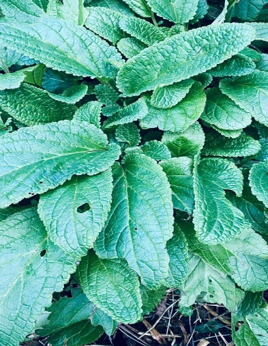
Comfrey naturally favours fertile, moisture-retentive soils.
It is frequently encountered near rivers, streams, drainage ditches, damp meadows and other places where the ground remains reasonably moist throughout the growing season.
Unlike Mediterranean herbs such as thyme, comfrey generally prefers a soil that does not dry excessively.
It grows well in full sun or partial shade, provided adequate moisture and nutrients are available.
Soil Requirements
Deep, fertile soil containing generous amounts of organic matter provides favourable conditions.
Well-rotted compost can improve soil structure and moisture retention.
Although comfrey appreciates moisture, persistently waterlogged conditions can interfere with healthy root development.
Propagation
Comfrey can be propagated through seed, crown division or root cuttings, depending on the species and cultivar.
Some cultivated forms, particularly certain Russian comfrey selections, are sterile and are normally propagated vegetatively.
Crown divisions containing healthy shoots and established roots often provide a practical method of propagation.
Root cuttings may also develop into new plants, although establishment depends on the condition of the material and the growing environment.
Establishing Young Plants
Despite comfrey’s reputation as a vigorous perennial, newly planted specimens may struggle before developing a substantial root system.
Competition from neighbouring plants, insufficient moisture, poor drainage, slug damage and weak planting material can all interfere with establishment.
For difficult sites, growing a healthy crown division in a large container before transplanting may improve the chances of success.
Once established, however, comfrey generally requires relatively little intervention.
Comfrey as a Garden Plant
Beyond its historical medicinal reputation, comfrey is widely appreciated by gardeners.
Its abundant foliage is used in composting and as a source of plant material for homemade garden fertilisers.

The flowers also provide a useful nectar source for pollinating insects.
Because of its vigorous root system, planting location deserves consideration.
A mature comfrey plant may remain in the same position for many years.
Harvesting and Drying
The timing of harvesting depends on whether leaves or roots are being collected.
Harvesting Leaves
Comfrey leaves are traditionally harvested during active growth, generally from spring through summer.
Healthy leaves should be selected from correctly identified plants growing away from contaminated ground, busy roads and areas treated with agricultural chemicals.
Gloves are advisable because the coarse leaf hairs may irritate the skin.
When harvesting from an established plant, removing only part of the foliage allows continued growth.
Harvesting Roots
Roots are traditionally lifted during autumn or early spring.
At these times, the plant is either entering or emerging from its dormant period.
Freshly harvested roots should be cleaned carefully to remove soil.
Larger roots may be cut into smaller sections to facilitate drying.
Because comfrey roots can regenerate from fragments, harvesting may not permanently remove the plant.
Drying Leaves
Leaves should be dried in a well-ventilated environment, protected from excessive moisture.
They may be spread in thin layers to encourage even drying.
Care should be taken to prevent mould development.
Drying Roots
Roots require particularly thorough drying because their dense structure retains moisture.
Cleaning, slicing and adequate airflow are important for preventing deterioration during storage.
Storage
Dried material should be stored in clearly labelled containers away from moisture and direct sunlight.
The botanical name, plant part and harvest date should be recorded.
Drying does not reliably remove pyrrolizidine alkaloids.
Consequently, dried comfrey should not be regarded as safe for internal consumption or automatically suitable for medicinal preparations.
Phytochemistry
Comfrey’s medicinal reputation is associated with a complex mixture of naturally occurring plant constituents.
Among the best known are allantoin, rosmarinic acid, mucilage, tannins and various phenolic compounds.
However, its phytochemical profile also includes pyrrolizidine alkaloids, which are central to understanding the plant’s toxicological risks.
Allantoin
Allantoin is one of the constituents most frequently associated with comfrey.
It is widely used in cosmetic and dermatological products because of its skin-conditioning and soothing properties.
Research involving allantoin has investigated its relationship with cellular processes involved in tissue repair.
This has contributed to interest in comfrey’s traditional association with damaged tissues.
Nevertheless, the activity of isolated allantoin should not be treated as proof that every comfrey preparation accelerates healing.
Rosmarinic Acid
Rosmarinic acid is a polyphenolic compound found in several medicinal plants.
It has demonstrated antioxidant and anti-inflammatory activities in experimental research.
These properties may contribute to the effects observed with certain comfrey extracts.
Inflammatory processes involve complex signalling pathways, and compounds such as rosmarinic acid may influence some of these mechanisms.
However, laboratory findings do not necessarily predict the effects achieved when a preparation is applied to human skin.
Mucilage
Comfrey contains mucilaginous polysaccharides that absorb and retain water.
These substances contribute to the slippery texture of freshly cut roots and crushed leaves.
Historically, this characteristic made comfrey particularly suitable for moist poultices.
The soft consistency allowed plant material to conform closely to the surface of the skin.
Tannins
Tannins are naturally occurring plant polyphenols with astringent properties.
They may contribute to some of the effects of traditional topical preparations.
Their precise role in the clinical effectiveness of standardised comfrey products remains less clearly established than the overall effects observed in clinical trials.
Pyrrolizidine Alkaloids
Pyrrolizidine alkaloids are among the most important compounds to consider when assessing comfrey.
Certain unsaturated PAs are capable of causing liver injury following sufficient exposure.
Some also possess genotoxic and carcinogenic potential.
The concentration and composition of these alkaloids can vary considerably between species, plant parts and individual samples.
This variability presents a particular challenge when preparing homemade extracts.
The presence of beneficial constituents does not cancel the toxicological significance of PAs.
For this reason, modern medicinal use focuses on appropriately manufactured topical products with controlled alkaloid exposure.
Traditional Herbal Uses
For generations, comfrey was regarded as one of Europe’s most useful external medicinal herbs.
Its reputation developed primarily around injuries affecting muscles, joints and connective tissues.
Bruising
Comfrey poultices were traditionally applied to bruised areas following minor injuries.
The plant’s reputation for reducing discomfort and swelling contributed to its popularity in household herbal medicine.
Modern studies involving specific topical preparations have reported beneficial effects on symptoms associated with soft-tissue injuries.
Sprains and Strains
Sprains and strains are among comfrey’s best-known traditional indications.
A sprain involves injury to ligaments, while a strain affects muscles or tendons.
Both can produce pain, swelling and reduced movement.
Traditional herbalists used comfrey externally in an attempt to relieve these symptoms.
Modern clinical trials provide some support for short-term symptomatic benefit from particular topical formulations.
Muscular Discomfort
Comfrey was historically used for aching muscles following physical work, injury or exertion.
Ointments and compresses were applied externally to affected areas.
Contemporary research has investigated standardised comfrey preparations for acute back pain and other muscular complaints.
Joint Discomfort
Comfrey also developed a reputation for easing painful or swollen joints.
Modern studies have examined topical comfrey in osteoarthritis, particularly involving the knee.
Some results suggest improvements in pain and function.
However, symptom relief should not be confused with regeneration of damaged cartilage.
Bone Injuries
The historical names Knitbone and Boneset reflect the belief that comfrey could assist the union of fractured bones.
This belief was widespread in traditional European herbalism.
However, modern clinical evidence does not establish that comfrey accelerates fracture healing in humans.
Suspected fractures require appropriate medical assessment and treatment.
Skin Applications
Comfrey was historically used on superficial skin injuries.
Its allantoin content has contributed to interest in tissue recovery.
Nevertheless, modern safety guidance discourages applying comfrey preparations to broken or damaged skin because of uncertainty concerning absorption of potentially harmful constituents.
Modern Scientific Research
Comfrey is unusual among many traditional medicinal herbs because several of its topical applications have been investigated in randomised clinical trials.
Acute Ankle Sprains
Clinical studies involving standardised comfrey-root preparations have reported reductions in pain and swelling following acute ankle injuries.
One controlled trial involving 142 patients found improvements in symptoms with a comfrey-root extract ointment compared with placebo.
Another trial involving 164 patients compared a comfrey-root preparation with topical diclofenac gel.
The findings suggested that the studied comfrey preparation was not inferior to diclofenac for certain measured outcomes during the short treatment period.
These results are encouraging but should not be generalised to all comfrey products.
Acute Back Pain
Randomised trials have investigated comfrey-root extract ointments for acute upper and lower back pain.
Some studies reported greater pain reduction with comfrey than with placebo.
The findings suggest a possible role for selected topical preparations in short-term symptomatic management.
Osteoarthritis
Clinical investigations involving knee osteoarthritis have reported improvements in pain and certain functional measures.
However, the available evidence remains limited.
Comfrey has not been demonstrated to reverse osteoarthritis or restore damaged cartilage.
Limitations of the Evidence
An important consideration is that clinical trials have investigated particular extracts and formulations.
Their findings cannot automatically be applied to homemade poultices, tinctures, infused oils or preparations made from different comfrey species.
The European Medicines Agency’s herbal monograph recognises a specific comfrey-root preparation for traditional use in relieving minor sprains and bruises.
The EMA’s conclusion is based on longstanding traditional use rather than treating the trials of other formulations as direct evidence for that particular preparation.
This distinction is essential when interpreting research.
Practical Preparations
Comfrey has historically been prepared in several different ways.
Understanding these methods provides insight into traditional herbal practice, although the presence of pyrrolizidine alkaloids requires particular caution.
Fresh Comfrey Poultice
Fresh leaves or roots were traditionally crushed into a moist paste and applied externally.
The mucilaginous texture of the plant made it suitable for forming a soft covering over an affected area.
Such poultices were commonly associated with bruising, swelling and musculoskeletal discomfort.
However, homemade fresh-plant preparations have not undergone the chemical testing required to establish controlled PA exposure.
They should not be regarded as equivalent to regulated topical medicines.
Comfrey-Infused Oil
Traditional herbalists prepared infused oils by steeping comfrey plant material in carrier oils.
These oils were subsequently incorporated into massage preparations and balms.
However, oil infusion does not provide a validated method of controlling pyrrolizidine alkaloid exposure.
The chemical composition of a homemade infusion cannot be reliably determined without laboratory analysis.
Comfrey Ointment


Ointments remain among the most familiar modern comfrey preparations.
Commercially manufactured products may contain standardised extracts with controlled PA levels.
For medicinal application, an appropriately regulated product is preferable to an untested homemade preparation.
Comfrey Tincture
Alcohol extracts a range of plant constituents and may also extract potentially harmful alkaloids.
Homemade comfrey tinctures should therefore not be consumed or assumed suitable for medicinal application.
Comfrey Tea
Comfrey tea was historically consumed for various complaints.
Modern toxicological evidence does not support this practice.
Comfrey should not be taken internally because of the risk of liver toxicity.
Safety and Contraindications
Comfrey has been used externally in traditional European herbal medicine for centuries, particularly for bruises, sprains, muscular discomfort and painful joints.
While modern research has identified important toxicological concerns associated with the plant, it is essential to distinguish between internal consumption and topical application.
These two routes of administration do not produce identical levels of exposure.
Understanding Pyrrolizidine Alkaloids
Comfrey naturally contains pyrrolizidine alkaloids (PAs), a group of plant compounds that includes substances capable of causing liver injury.
Certain unsaturated pyrrolizidine alkaloids can be metabolised into reactive compounds that damage liver cells. Some also possess genotoxic and carcinogenic potential.
The concentrations of these alkaloids vary according to the comfrey species, plant part, growing conditions and preparation method.
Roots generally contain higher concentrations than leaves, although considerable variation exists.
This variability is one reason why the safety of homemade preparations cannot be determined simply by measuring the amount of plant material used.
Internal Use Versus Topical Application
The distinction between swallowing comfrey and applying it to the skin is particularly important.
When comfrey is consumed internally, pyrrolizidine alkaloids may be absorbed through the digestive tract and subsequently metabolised by the liver.
This route of exposure has been associated with serious liver toxicity, including hepatic sinusoidal obstruction syndrome.
For this reason, comfrey should not be consumed as a medicinal tea, tincture, powder, capsule or other internal preparation.
Topical application presents a different situation.
The outermost layer of the skin, known as the stratum corneum, acts as an important protective barrier. It restricts the penetration of many substances and can substantially reduce systemic exposure compared with oral administration.
However, the skin is not an impermeable barrier.
Experimental evidence indicates that some pyrrolizidine alkaloids can penetrate intact skin, although the extent of absorption depends on the particular compounds and formulation.
Consequently, topical application generally presents a lower potential for systemic exposure than ingestion, but it does not eliminate exposure entirely.
Does Topical Comfrey Present the Same Risks as Internal Comfrey?
No. The two routes of administration should not be treated as equivalent.
The most serious documented cases of comfrey-associated liver toxicity have involved internal consumption of preparations containing pyrrolizidine alkaloids.
The evidence concerning liver injury following ordinary topical comfrey use is much more limited.
This is an important distinction when assessing the plant’s traditional applications.
It would be misleading to suggest that applying a small quantity of comfrey ointment to intact skin necessarily carries the same risk as regularly drinking comfrey tea.
However, limited evidence of harm from topical use does not establish that every homemade preparation is safe.
The actual risk depends on the concentration of toxic alkaloids, the amount applied, the condition of the skin, the duration of treatment and the frequency of application.
Why Skin Integrity Matters
Healthy, intact skin provides a significant barrier against the absorption of externally applied substances.
When skin is damaged, that barrier may be compromised.
Cuts, abrasions, ulcers, dermatitis and other conditions affecting skin integrity may increase the penetration of certain compounds.
For this reason, comfrey preparations should not be applied to open wounds, ulcers or broken skin.
This precaution is particularly important in people with diabetes, impaired circulation, peripheral neuropathy or conditions associated with delayed wound healing.
Understanding the European Medicines Agency Limit
The European Medicines Agency (EMA) has assessed a specific comfrey-root preparation for traditional topical use in adults.
Its herbal monograph specifies a maximum daily exposure of 0.35 micrograms (µg) of pyrrolizidine alkaloids for the preparation concerned.
To appreciate how small this quantity is:
- 1 milligram equals 1,000 micrograms.
- 0.35 micrograms equals 0.00035 milligrams.
- 0.35 micrograms equals 0.00000035 grams.
Importantly, this limit refers to exposure to pyrrolizidine alkaloids, not to the total weight of comfrey leaves, roots or ointment.
It is a precautionary exposure limit intended to minimise potential toxicological risks, particularly those associated with genotoxic compounds.
It should not be interpreted as a precise threshold at which liver damage suddenly occurs.
For example, exceeding 0.35 µg does not automatically mean that liver injury will result.
Equally, remaining below this limit does not establish that every possible pattern of exposure is entirely without risk.
The limit is specific to the regulatory assessment of the relevant preparation and should not be treated as a universal safety guarantee for all comfrey products.
Can Pyrrolizidine Alkaloids Be Measured in Homemade Preparations?
For most home herbalists, accurately determining pyrrolizidine alkaloid concentrations is not practically achievable.
These substances occur in very small quantities and require specialised laboratory analysis.
Methods such as liquid chromatography coupled with tandem mass spectrometry (LC-MS/MS) can identify and quantify individual alkaloids at extremely low concentrations.
Simply weighing fresh leaves, dried roots or finished ointment does not establish how much PA is present.
Furthermore, extraction methods influence which constituents enter the finished preparation.
An infused oil, alcoholic tincture and commercially manufactured extract may therefore have substantially different chemical compositions.
Without appropriate testing, a homemade comfrey preparation cannot be described as pyrrolizidine-alkaloid controlled.
Traditional Homemade Comfrey Preparations
Comfrey has traditionally been prepared as fresh poultices, infused oils, compresses and ointments.
These practices form an important part of European herbal history.
Occasional external application to intact skin is likely to result in substantially less systemic exposure than internal consumption, although the degree of exposure cannot be reliably predicted for an individual homemade preparation.
There is insufficient evidence to establish that all occasional homemade topical applications are harmless.
The absence of widespread reports of liver injury from traditional external use should not be confused with proof of safety.
From a modern toxicological perspective, preparations with analytically controlled PA content provide greater assurance than untested homemade products.
Duration and Frequency of Application
The duration and frequency of exposure are important considerations.
Repeated application over large areas of skin may increase cumulative exposure.
Application beneath occlusive dressings may also alter skin penetration, depending on the formulation.
For the specific preparation covered by the EMA herbal monograph, use is restricted to adults and a maximum duration of ten days.
Other authorised products may have different instructions, which should be followed.
Pregnancy and Breastfeeding
Medicinal comfrey preparations should be avoided during pregnancy and breastfeeding because of toxicological concerns and insufficient safety data.
Children
Comfrey preparations should not be used on children unless the particular authorised product specifically permits their use.
Liver Disease
Individuals with liver disease should avoid internal comfrey entirely and seek professional medical advice before considering topical preparations.
Allergic Reactions and Skin Sensitivity
Comfrey may occasionally cause local irritation or allergic skin reactions.
Individuals with known sensitivity to comfrey or related plants should avoid its use.
Any preparation should be discontinued if irritation, redness, itching or other signs of sensitivity develop.
A Balanced Perspective on Comfrey Safety
Comfrey provides an important example of why the route of administration must be considered when evaluating medicinal plants.
Internal consumption carries recognised risks associated with pyrrolizidine alkaloids and is not recommended.
Topical application to intact skin generally presents a lower potential for systemic exposure, particularly when used for a short period.
However, the safety of homemade preparations cannot be established without knowing their alkaloid content.
Modern research supports the therapeutic potential of certain standardised topical comfrey products, while toxicological knowledge provides the framework for their responsible use.
The objective is not to dismiss comfrey’s long history in traditional medicine, but to understand how its benefits can be considered alongside its risks. Traditional knowledge tells us why comfrey became valued. Modern science helps us understand how to use that knowledge more responsibly.
🌿 Did You Know? 🌿
Comfrey is famous among gardeners for its ability to regenerate from small pieces of root.
This makes it a remarkably persistent perennial once established.
Ironically, that same plant can sometimes prove surprisingly difficult to establish in the first place.
Catherine’s Reflection
One of the fascinating aspects of studying medicinal plants is discovering how closely their historical names reflect the observations of earlier generations.
Comfrey’s reputation as Knitbone tells us something about the importance it held in traditional European medicine.
Our ancestors observed plants carefully and developed remedies from the materials available to them.
Today, modern research allows us to investigate those observations in greater detail.
In comfrey’s case, scientific investigation has identified potentially useful topical applications while also revealing important toxicological risks.
For me, this is precisely why herbal medicine benefits from bringing traditional knowledge and contemporary clinical understanding together.
We do not need to dismiss centuries of herbal practice, but neither should we assume that every historical preparation is safe simply because it has been used for generations.
Catherine’s Herbal Notes
Handmade Comfrey Ointment — Holistic Healthcare Wexford. Photograph from the author’s herbal preparation collection.

Harvest season: Leaves during spring and summer; roots traditionally in autumn or early spring.
Parts used: Leaves and roots.
Favourite preparation: Comfrey has a long tradition of use in poultices and ointments. For medicinal topical use, appropriately manufactured preparations with controlled pyrrolizidine alkaloid content offer a more reliable safety profile than untested homemade extracts.
Growing location: Although I cultivate numerous medicinal herbs in my garden in County Wexford, Ireland, comfrey has repeatedly struggled to establish itself.
I therefore rely on fellow growers who generously provide me with plant material.
Personal observations:
There is something rather amusing about comfrey’s reluctance to grow in my garden.
Here is a plant renowned for its persistence, capable of regenerating from fragments of root and often described as almost impossible to eradicate once established.
Yet in my own medicinal herb garden, it seems to have other ideas.
Despite attempts to grow it, comfrey struggles during its early establishment.
Fortunately, fellow growers have been generous enough to share their harvests.
It is a reminder that gardening, much like herbal medicine itself, rarely follows a perfectly predictable formula.
Every plant responds to its surroundings, and sometimes the plants with the strongest reputations turn out to be the most contrary.
Final Thoughts
Comfrey is one of those remarkable medicinal plants whose story stretches across centuries of European herbal tradition.
From the gardens of monasteries to the writings of early herbalists, from rural household remedies to modern phytotherapy, it has maintained a reputation closely associated with the treatment of injuries and musculoskeletal discomfort.
Its historical names reveal the confidence once placed in its healing properties.
Modern research has provided evidence that certain topical comfrey preparations can reduce pain and swelling in selected conditions.
At the same time, toxicological investigations have demonstrated why internal use and untested homemade medicinal preparations require serious caution.
For me, comfrey represents something important about the continuing development of herbal medicine.
Traditional knowledge provides the questions.
Scientific investigation helps us explore the answers.
And practical experience reminds us that plants are complex living organisms, not simply collections of isolated chemical compounds.
Perhaps comfrey will eventually decide to establish itself in my Wexford garden.
Until then, I remain grateful to the fellow growers who share their plants and allow me to continue studying this fascinating herb.
I hope this article encourages you to look more closely at comfrey, appreciate its place in European herbal history and understand both its therapeutic potential and its limitations.
Look after your body, and it will help look after you.
Catherine

CWD | 17 October 2026 | Ireland
Holistic Healthcare Wexford
Integrative · Mindful · Patient-Centred
References and Further Reading
- European Medicines Agency. Symphyti radix — Herbal medicinal product. European Union herbal monograph and public summary.
https://www.ema.europa.eu/en/medicines/herbal/symphyti-radix - Staiger C. Comfrey: A Clinical Overview. Phytotherapy Research. 2012;26(10):1441–1448.
https://pmc.ncbi.nlm.nih.gov/articles/PMC3491633/ - Comfrey Root: From Tradition to Modern Clinical Trials. Review of clinical evidence and traditional applications.
https://pmc.ncbi.nlm.nih.gov/articles/PMC3580139/ - Symphytum Species: A Comprehensive Review on Chemical Composition, Food Applications and Phytopharmacology.
https://pmc.ncbi.nlm.nih.gov/articles/PMC6780234/ - European Medicines Agency. Assessment Report on Symphytum officinale L., radix.
https://www.ema.europa.eu/en/medicines/herbal/symphyti-radix - Krautgeschwister. Wusel, ein schmerzender Fußballen und frischer Beinwell. Sonja M. Bart, 5 October 2026.
https://krautgeschwister.de/schmerzender-fussballen-und-frischer-beinwell/
About the Author
Dr Catherine W. Dunne MSc.D. is a Registered General Nurse with over 38 years of clinical experience in primary care in Ireland. Alongside her work in General Practice Nursing, she is the founder of Holistic Healthcare Wexford and co-founder of Aumvedas Academy.
With a background that bridges conventional medicine and holistic practice, Catherine has a particular interest in the area where patients are often told “everything is normal,” yet still feel unwell. Her work focuses on helping people understand what their body is communicating, especially in relation to energy, stress, metabolic function, and recovery.
Through a combination of clinical knowledge and holistic support, she works with individuals to restore balance, improve resilience, and support long-term wellbeing.
Based in Wexford, Ireland.
Disclaimer
This article is for informational and educational purposes only and is not intended as medical advice. It does not replace consultation with a qualified healthcare professional. Patients should always seek appropriate medical guidance regarding their individual health needs and before making changes to treatment or care.
AI-Disclaimer:
About the images: Unless otherwise stated, the photographs used throughout this library are the author’s own. AI-assisted design tools may be used to create educational layouts, improve presentation, and incorporate Holistic Healthcare Wexford branding. The botanical content and educational purpose remain those of the author.

