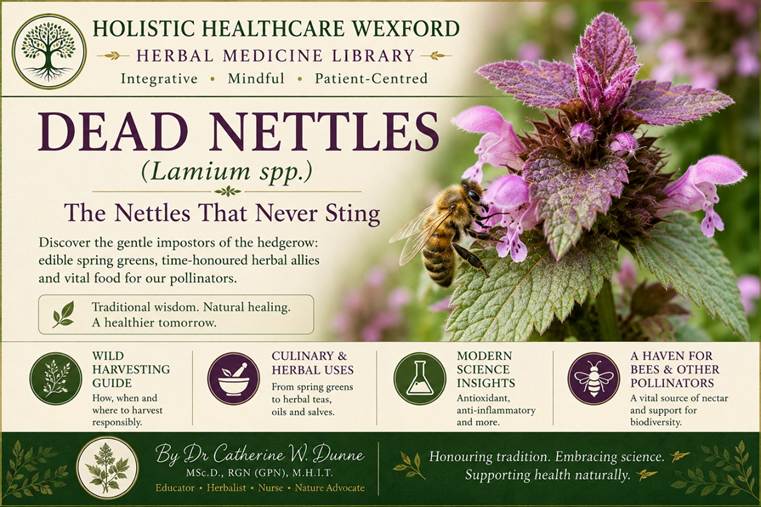
The Nettles That Never Sting
Part of the Holistic Healthcare Wexford Herbal Medicine Library
By Dr Catherine W. Dunne, MSc.D., RGN (GPN), M.H.I.T., I.R.E.T.
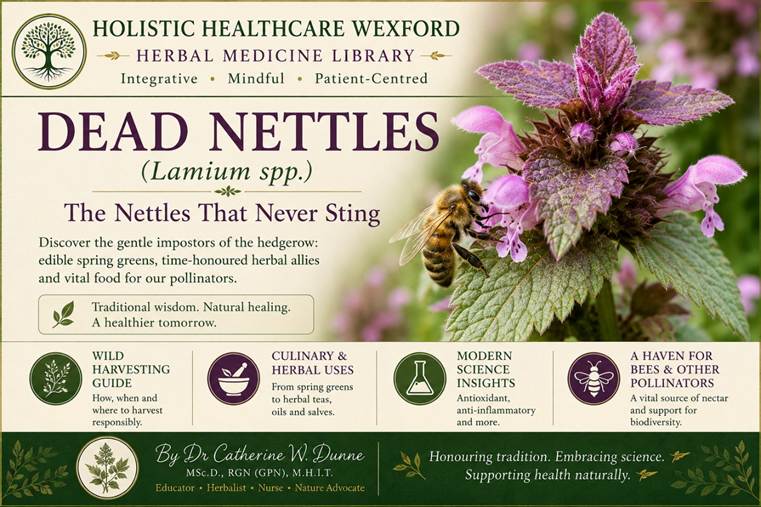
Meet the Gentle Impostor
If I were to ask you to reach out and touch a nettle, chances are you would hesitate.
Most of us have learnt from childhood to avoid them. We remember the sharp sting, the burning sensation and the tiny blisters that seem to appear almost instantly. Nettles have earned our respect.
Now imagine walking along an Irish hedgerow in early spring.
You notice another patch of what appears to be young nettles. The leaves are serrated. The stems stand upright. Everything about them says, “Don’t touch.”
Yet curiosity gets the better of you.
You gently place your fingers on the leaves.
Nothing happens.
No sting.
No burning.
No itching.
Instead, you have just met one of nature’s greatest botanical impostors—the Dead Nettles.
Despite their striking resemblance to the familiar Stinging Nettle, these beautiful wildflowers belong to an entirely different botanical family. They are gentle, colourful, rich in nectar and have quietly accompanied people for centuries as edible spring greens, medicinal herbs and valuable food for pollinating insects.
Their story is one that deserves to be told.
A Plant That Pretends to Be a Nettle
The name Dead Nettle has puzzled generations of walkers, gardeners and herbalists.
Surely a plant called “dead” cannot be very interesting?
In fact, the opposite is true.
The word dead has nothing whatsoever to do with the plant being lifeless or useless. It simply distinguishes these harmless plants from the true Stinging Nettles (Urtica species).
The resemblance is remarkable.
Both possess opposite leaves with sharply serrated edges.
Both favour hedgerows, woodland edges, gardens and disturbed ground.
Both emerge early in the growing season.
Yet botanically they are only distant relatives.
The true nettles belong to the Nettle family (Urticaceae).
Dead Nettles belong to the Mint family (Lamiaceae), one of the largest and most economically important plant families in the world. This is the same family that gives us mint, thyme, sage, rosemary, oregano, basil, lavender and lemon balm.
Once you know this, everything begins to make sense.
The square stems.
The opposite leaves.
The beautiful hooded flowers.
The busy bees.
The absence of any sting.
Dead Nettles are, quite literally, mints disguised as nettles.
Nettle: Dead or Alive… that is the question
One of the pleasures of learning about plants is discovering that appearances can be wonderfully deceptive.
From a distance, many people mistake Purple Dead-nettle for a young Stinging Nettle. Even experienced walkers sometimes need to look twice before the flowers appear.
Your own photographs illustrate this perfectly.
The Stinging Nettle produces elongated pointed leaves armed with countless microscopic stinging hairs. Before flowering, its developing shoots can easily resemble those of Dead Nettles. It is only when the flowers begin to develop that the difference becomes obvious.
Instead of colourful blossoms, Stinging Nettles produce long, green drooping clusters of tiny flowers designed for wind pollination.
Dead Nettles take an entirely different approach.
Their flowers are large, colourful and unmistakably designed to attract insects. White, pink, purple or yellow blooms form in neat whorls around the stem, each flower acting like a tiny landing platform for hungry bees.
Once flowering begins, confusion disappears.
One plant trusts the wind.
The other courts the bees.
That simple difference tells us we are looking at two entirely different families of plants.
Learning to Recognise a Dead Nettle
One of the wonderful things about the Lamium family is that once you learn a handful of identifying features, you begin to recognise them almost everywhere.
Rather than relying upon a single characteristic, experienced botanists look for several clues together.
Square stems
Perhaps the easiest feature to demonstrate—and one beautifully captured in your own photograph—is the square stem.
Most people imagine a stem to be round.
Dead Nettles are different.
Gently roll the stem between your fingers.
Instead of feeling cylindrical, it has four distinct sides.
This square profile is one of the classic hallmarks of the Mint family and immediately narrows the possibilities.
Of course, a square stem alone does not identify a Dead Nettle. Many other familiar herbs share this feature, including thyme, peppermint, sage, rosemary and lemon balm.
It is simply the first clue.
Opposite leaves
The leaves arise in pairs directly opposite one another.
Each successive pair is positioned at right angles to the pair below, creating a beautifully balanced arrangement along the stem.
Once you begin looking for opposite leaves, you will notice this pattern repeated throughout the Mint family.
Two-lipped flowers
Perhaps the most beautiful feature of all is the flower itself.
Botanists describe these flowers as bilabiate, meaning “two-lipped.”
The upper lip forms a protective hood over the reproductive structures.
The lower lip acts as a convenient landing platform for bees.
Nature has engineered the flower with remarkable efficiency.
As the bee enters in search of nectar, pollen is deposited onto its body before being carried to the next flower.
It is an elegant partnership that has evolved over millions of years.
No stinging hairs
Finally, there is the feature everyone appreciates.
Dead Nettles do not sting.
Unlike their notorious cousins, they lack the specialised hollow hairs capable of injecting irritating chemicals into the skin.
They can be safely handled, photographed, studied and harvested with bare hands.
For anyone new to wild plants, that single fact often comes as a delightful surprise.
So, How Do They Compare?
Now that we’ve met the Dead Nettles, let’s place them alongside their better-known cousin, the Stinging Nettle. Although they are often confused at first glance, the differences become surprisingly obvious once you know what to look for.
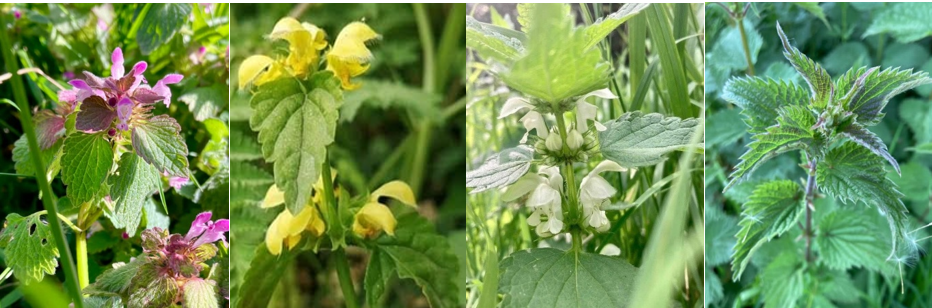
Figure 1. Members of the Dead Nettle family commonly found in Ireland. From left to right: Purple Dead-nettle (Lamium purpureum), Yellow Archangel (Lamium galeobdolon), White Dead-nettle (Lamium album), together with Stinging Nettle (Urtica dioica) for comparison.
Not All Nettles Sting
Despite their similar appearance, Dead Nettles and Stinging Nettles are only distant botanical relatives. Their shared common name reflects the resemblance of their leaves rather than a close family relationship. In fact, Dead Nettles belong to the Mint family (Lamiaceae), whereas Stinging Nettles belong to the Nettle family (Urticaceae).
The easiest way to distinguish them is simply to touch the plant. True nettles are covered with tiny hollow hairs that inject irritating compounds into the skin, producing the familiar burning sensation. Dead Nettles lack these stinging hairs entirely, making them safe to handle with bare hands.
Once you know what to look for, the differences become surprisingly obvious.
| Characteristic | Dead Nettles (Lamium spp.) | Stinging Nettle (Urtica dioica) |
|---|---|---|
| Plant Family | Lamiaceae (Mint Family) | Urticaceae (Nettle Family) |
| Stings? | ❌ No | ✅ Yes |
| Stem | Square | Round to slightly ridged |
| Leaves | Opposite pairs, often softly hairy | Opposite pairs with abundant stinging hairs |
| Flowers | Showy white, purple, pink or yellow two-lipped flowers | Small green, inconspicuous flowers hanging in clusters |
| Pollination | Mainly bees and other insects | Primarily wind pollinated |
| Aroma | Mild, sometimes slightly herbal | Green, earthy scent when crushed |
| Edibility | Young leaves and flowers edible | Young leaves edible after cooking or drying |
| Traditional Uses | Food, herbal medicine, pollinator plant | Food, fibre, herbal medicine and traditional textiles |
Although they may appear similar when young, they have followed very different evolutionary paths. One evolved to defend itself with stinging hairs and relies largely on the wind to carry its pollen. The other invested in colourful flowers, nectar and partnerships with bees and other pollinating insects.
Meet the Family
Once you become familiar with the Dead Nettles, you’ll begin noticing that they are not a single plant but a fascinating family of closely related species. Each has its own personality, preferred habitat and subtle differences, yet all share the unmistakable characteristics of the Lamium genus.
Three species are particularly familiar to walkers in Ireland and the United Kingdom, while two others are often encountered in gardens or specialised habitats.
Purple Dead-nettle (Lamium purpureum)
The Herald of Spring
If there is one Dead Nettle that announces the arrival of spring, it is Purple Dead-nettle.
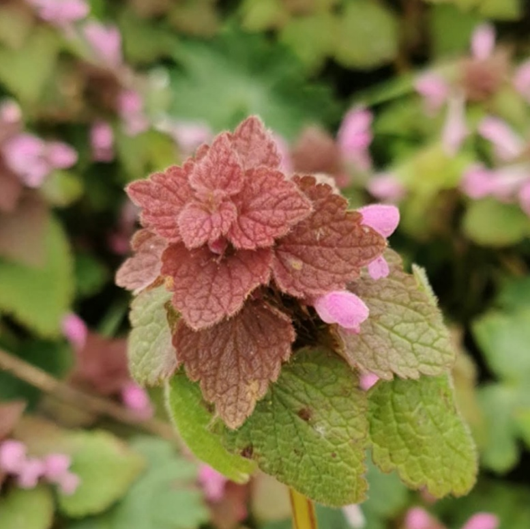
Often appearing while winter still lingers, it carpets gardens, roadside verges, cultivated fields and neglected corners with a wash of soft pink flowers and reddish-purple foliage. At a time when few other wildflowers have begun to bloom, it provides an invaluable source of nectar for early bumblebees emerging from hibernation.
One of its most distinctive features is the cluster of reddish or purplish leaves at the top of the plant. These colourful upper leaves surround the flowers like a protective rosette, making the species surprisingly easy to recognise once you know what to look for.
Although many gardeners regard it as little more than another weed, Purple Dead-nettle has long been appreciated by foragers. The young leaves are edible, mild in flavour and rich in vitamins, minerals and naturally occurring plant compounds.
From a botanical perspective, it perfectly demonstrates the defining characteristics of the Mint family: a square stem, opposite leaves and beautiful two-lipped flowers designed for insect pollination.
In the Field
Purple Dead-nettle is usually the first member of the family I notice each year. Long before many other wildflowers appear, these cheerful patches of pink begin lighting up grassy verges and hedgerows. Even before I see the flowers, I often notice the bees.
White Dead-nettle (Lamium album)
The Bumblebees’ Favourite
Where Purple Dead-nettle whispers that spring has arrived, White Dead-nettle seems to celebrate the abundance of summer.
Its elegant white flowers are among the largest within the genus and are arranged in neat whorls around the stem. Unlike the delicate pink flowers of its purple cousin, these creamy white blossoms are bold and unmistakable.
Stand quietly beside a patch on a warm day and you’ll soon hear the gentle hum of bumblebees. White Dead-nettle is one of their favourite nectar plants. Its deep tubularflowers are particularly well suited to long-tongued bumblebees, which effortlessly disappear inside each bloom before emerging dusted with pollen.
Historically, this has been the most respected medicinal member of the genus. Across Europe it was gathered by herbalists to prepare teas, tinctures and poultices for a wide variety of traditional purposes, particularly those relating to women’s health, respiratory wellbeing and minor skin complaints.
To me, however, its greatest gift is perhaps simpler.
It reminds us that some of nature’s most generous plants are those growing quietly at the edge of a field, unnoticed by almost everyone who passes.
🐝 Bee Note
White Dead-nettle is one of the most important early nectar sources for bumblebees in Britain and Ireland. Allowing even a small patch to flower can provide valuable food for pollinating insects.
Yellow Archangel (Lamium galeobdolon)
The Quiet Woodland Cousin
Unlike its colourful relatives that favour open ground and sunny verges, Yellow Archangel prefers the cool tranquillity of woodland.
Here, beneath the dappled shade of mature trees, its bright yellow flowers seem almost to glow against the darker greens of the forest floor.
Many cultivated varieties display attractive silver markings on their leaves, making them popular ornamental ground-cover plants. The wild form, however, possesses a quieter beauty that blends naturally into ancient woodland habitats.
Although it has never achieved the medicinal reputation of White Dead-nettle, it shares the same square stems, opposite leaves and hooded flowers that define the Lamium genus. Historically it was occasionally employed as a mild wound herb and general tonic, though today it is perhaps valued even more for the shelter and nectar it provides to woodland insects.
Whenever I come across Yellow Archangel, it always feels like finding a hidden treasure.
While Purple Dead-nettle cheerfully announces itself from roadside verges, Yellow Archangel waits patiently beneath the trees for those willing to wander a little further.
Henbit Dead-nettle (Lamium amplexicaule)
The Little Wanderer
Henbit is a smaller, more delicate member of the family and often appears in cultivated ground, vegetable gardens and newly disturbed soil.
Its upper leaves clasp the stem—a feature reflected in its botanical name amplexicaule, meaning “stem-embracing”. This simple characteristic makes it surprisingly easy to identify.
Although less well known in European herbal medicine, Henbit has traditionally been gathered as a nutritious spring green and is another welcome source of nectar for early pollinators.
Its modest appearance reminds us that even the smallest wildflowers have an important role within the ecosystem.
Spotted Dead-nettle (Lamium maculatum)
Beauty in the Shade
Spotted Dead-nettle is perhaps the species most familiar to gardeners.
Its striking silver-patterned leaves and pink, purple or white flowers have made it one of the most widely cultivated ground-cover plants in Europe.
Although admired primarily for its ornamental value, it remains every bit as much a member of the Dead Nettle family as its wild cousins. Bees readily visit its flowers, and it shares many of the same traditional herbal associations.
It demonstrates beautifully that medicinal plants and ornamental plants are often one and the same.
Sometimes we simply forget to look beyond the flower bed.
Other Members of the Lamium Family
The Lamium genus contains around 40–50 recognised species, several of which are found elsewhere in Europe and Asia or are commonly grown as ornamental garden plants.
Among these are Henbit Dead-nettle (Lamium amplexicaule), often found in cultivated ground and field margins, and Spotted Dead-nettle (Lamium maculatum), a popular ornamental with attractive silver-marked leaves.
Although both share the characteristic square stems, opposite leaves and two-lipped flowers of the Lamium genus, they are less commonly encountered in my own field observations here in County Wexford. For that reason, this article focuses on the three species I most frequently see growing naturally in Ireland.
Why Are They Called “Dead” Nettles?
Few common plant names have caused as much misunderstanding as Dead Nettle.
To someone unfamiliar with the plant, the word dead almost suggests something lifeless, poisonous or of little value. Yet nothing could be further from the truth.
The name has nothing to do with the health or vitality of the plant. It simply distinguishes these harmless wildflowers from the familiar Stinging Nettle (Urtica dioica).
Unlike true nettles, Dead Nettles possess no stinging hairs. You can run your hand gently over their leaves without experiencing the sharp burning sensation that most of us associate with nettles.
Early herbalists and country folk simply needed an easy way to tell the two apart.
One stung.
One did not.
Over time, the harmless plants became known as Dead Nettles.
The name remained, even though these remarkable members of the Mint family continue to buzz with life throughout spring and summer.
Far from being “dead”, they provide nectar for bees, food for insects, edible greens for people and a long history of traditional medicinal use.
Sometimes, a name tells only part of the story.
How Herbalists Have Used Dead Nettles
For hundreds of years, Dead Nettles have quietly found their place in the herbal traditions of Europe.
Unlike many medicinal plants surrounded by dramatic folklore, Dead Nettles have always been rather modest. They were the herbs growing beside the cottage, along the hedgerow or at the edge of the vegetable garden. Readily available, easy to recognise and free for anyone willing to gather them.
Different species developed different reputations, although White Dead-nettle eventually became the best known medicinal member of the family.
🤍 White Dead-nettle
Traditional European herbalists regarded White Dead-nettle as a gentle but versatile herb.
Infusions prepared from the flowering tops were commonly used to support:
- respiratory wellbeing
- urinary comfort
- minor skin irritations
- women’s health
Externally, crushed leaves and flowers were made into washes or poultices for minor cuts, abrasions, insect bites and irritated skin.
Many nineteenth-century herbal texts describe it as a mild astringent and soothing herb, reflecting the observations of generations of practitioners.
💜 Purple Dead-nettle
Purple Dead-nettle occupied a slightly different place within traditional herbal practice.
Rather than being gathered solely as a medicine, it was often valued as both food and medicine.
The tender young leaves were added to spring salads, soups and simple broths after the long winter months, providing fresh green nourishment when cultivated vegetables remained scarce.
Traditional herbalists also prepared teas from the flowering tops and occasionally applied the fresh leaves directly to small cuts, scratches and insect bites.
Its reputation centred around supporting the body’s natural healing processes rather than acting as a powerful medicinal herb.
💛 Yellow Archangel
Yellow Archangel has a quieter herbal history.
Although mentioned less frequently in European herbals than White Dead-nettle, it was occasionally employed as a mild tonic and external wound herb.
Today it is perhaps appreciated more for its ecological value than its medicinal reputation.
Growing naturally beneath woodland canopies, it provides nectar for insects in places where relatively few flowering plants thrive.
Sometimes the greatest contribution a plant makes is not in the medicine cabinet but within the ecosystem itself.
A Word About Traditional Herbal Practice
It is important to remember that traditional herbal use represents generations of observation rather than modern clinical evidence.
People noticed patterns.
They observed which plants appeared helpful.
Those observations were passed from one generation to the next, long before laboratories, microscopes or clinical trials existed.
Some of those traditional observations have since gained scientific support.
Others remain largely untested.
Neither diminishes their historical importance.
Instead, they remind us that traditional knowledge and modern science are often partners in the same journey rather than competitors.
What Is Modern Science Discovering?
For centuries, Dead Nettles were gathered because people found them useful. Herbalists observed their effects, shared their knowledge and passed it from one generation to the next. They did not know about flavonoids, antioxidants or inflammatory pathways. They simply learnt from experience.
Today, researchers are beginning to ask why these plants earned their place in traditional herbal medicine.
Rather than simply asking “What was this herb used for?”, scientists are now exploring questions such as:
- What natural compounds does it contain?
- How do those compounds behave?
- Can traditional observations be explained scientifically?
Studies have shown that several species of Lamium contain naturally occurring compounds including flavonoids, phenolic acids, tannins, iridoid glycosides, vitamins and essential minerals. These compounds are not unique to Dead Nettles—they occur in many medicinal plants—but they are known to possess biological activity and continue to attract scientific interest.
Laboratory studies have demonstrated antioxidant, anti-inflammatory and antimicrobial activity in extracts of several Lamium species. These findings are encouraging because they provide possible explanations for some of the traditional uses recorded by herbalists over many generations.
As always, it is worth keeping the findings in perspective. Most of the research has been carried out in laboratories or experimental models, with relatively few human clinical trials completed so far. That does not diminish the value of the plant, but it reminds us that scientific understanding continues to evolve.
One of the things I enjoy most is seeing traditional herbal knowledge and modern research gradually meet in the middle. Sometimes science confirms what herbalists have observed for centuries. Sometimes it asks entirely new questions. Both are valuable.
As both a nurse and herbalist, I find that one of the most rewarding aspects of herbal medicine. The plants themselves have not changed. What continues to grow is our understanding of them.
Catherine’s Nursing Perspective
As a nurse, I often remind patients that traditional herbal knowledge and modern medicine need not compete with one another. One begins with generations of observation, the other with carefully designed scientific studies. Both have something to teach us, and both continue to evolve as our understanding grows.
Harvesting Dead Nettles
Dead Nettles are among the easiest wild herbs to harvest responsibly, provided they are correctly identified and collected from clean, unpolluted environments.
Choose plants growing well away from busy roads, industrial sites, areas treated with herbicides or places frequented by dogs or livestock. As with all wild harvesting, avoid protected sites and never remove an entire colony from one location.
The young leaves and flowering tops are generally considered the most desirable parts for both culinary and traditional herbal use. They are best gathered during spring and early summer while the plants are actively growing and before prolonged periods of hot, dry weather reduce their tenderness.
A small pair of scissors or secateurs makes harvesting simple. Snip only the upper portions of the plant, leaving the roots undisturbed so that the plant can continue to grow and flower naturally throughout the season.
Harvest only what you need.
Dead Nettles are generous plants, but perhaps their greatest gift is not what they provide for us—it is the food they continue to provide for bees long after we have gathered our own small share.
From Hedgerow to Kitchen
Many people are surprised to discover that Dead Nettles are edible.
Because they resemble Stinging Nettles, they are often overlooked as a food plant. Yet the young leaves have a mild flavour and can be enjoyed in much the same way as other spring greens.
Fresh leaves add colour and texture to mixed salads, particularly those of Purple Dead-nettle with their attractive reddish tones.
Lightly cooked, they can be added to soups, stews and vegetable dishes, where they contribute both flavour and nutrition without overwhelming the meal.
Some foragers also enjoy incorporating them into homemade pesto alongside other wild herbs, olive oil, garlic and nuts.
The flowering tops may be infused to make a gentle herbal tea, appreciated more for its pleasant character than for any dramatic medicinal effect.
As always, correct identification is essential before gathering any wild plant for the table.
Herbal Preparations
Throughout history, Dead Nettles have found their way into a variety of traditional herbal preparations.
The flowering tops have been dried for herbal infusions, while fresh material has been incorporated into tinctures, infused oils and soothing skin preparations.
One of the simplest ways to appreciate the plant is as a fresh infusion.
Gather the flowering tops on a dry morning after the dew has lifted, rinse them gently if required, and steep in freshly boiled water for around ten minutes. The resulting infusion has a mild, earthy flavour and reflects centuries of traditional herbal practice.
The flowering tops may also be infused into a good-quality carrier oil for use in balms and salves. As with all fresh herbs used in oil preparations, care should be taken to minimise moisture, reducing the risk of spoilage.
Although these preparations have a long history in traditional herbal medicine, they should be viewed as complementary to, rather than replacements for, appropriate medical care.
Nature’s Chemistry
Although Dead Nettles appear delicate, they are remarkable little chemical factories. Like many members of the Mint family, they produce a wide range of naturally occurring compounds including flavonoids, phenolic acids, tannins and iridoid glycosides. These substances help protect the plant in the wild and are also the focus of much modern herbal research.
Antioxidant Activity
Several Lamium species demonstrate significant antioxidant activity in laboratory studies.
Antioxidants help neutralise unstable molecules known as free radicals, which contribute to oxidative stress. Excessive oxidative stress has been associated with ageing and numerous chronic diseases, including cardiovascular disease, diabetes and neurodegenerative disorders.
Research suggests that the phenolic compounds and flavonoids present in Dead Nettles contribute substantially to this antioxidant capacity.
Anti-inflammatory Potential
Inflammation forms part of the body’s normal defence system, but persistent or excessive inflammation contributes to many chronic conditions.
Experimental studies suggest extracts from several Lamium species may influence inflammatory pathways by reducing the production of inflammatory mediators. While these findings are encouraging, most evidence currently comes from laboratory and animal models rather than large human clinical trials.
Consequently, further research is required before firm clinical recommendations can be made.
Antimicrobial Activity
A number of laboratory investigations have demonstrated that extracts from White Dead-nettle and Purple Dead-nettle possess activity against certain bacteria and fungi under experimental conditions.
Researchers believe that phenolic compounds, flavonoids and tannins contribute to these effects. However, laboratory activity does not necessarily translate directly into clinical effectiveness, and more human studies are needed.
Nutritional Value
Beyond their medicinal reputation, young Dead Nettle leaves are surprisingly nutritious.
They provide dietary fibre together with vitamins and minerals that contribute to a healthy diet. Their early spring emergence has historically made them an important seasonal food, particularly after long winters when fresh greens were scarce.
This nutritional value may itself explain why these plants earned such an enduring place in traditional herbal practice.
What Are the Limitations of the Evidence?
As with many traditional medicinal plants, research into Dead Nettles is still developing. Much of the available evidence comes from laboratory studies rather than large human clinical trials. While the results are encouraging, they should be viewed as adding to our understanding of the plant rather than providing definitive clinical proof of effectiveness.
A Haven for Bees and Other Pollinators
Long before people recognised the medicinal value of Dead Nettles, bees had already discovered their worth.
The distinctive two-lipped flowers of Lamium species are rich in nectar and provide an important food source for honeybees, bumblebees and a wide variety of solitary bees. Many species flower remarkably early in the year, often when few other wildflowers are available, making them an invaluable source of nutrition for pollinating insects emerging from winter.
White Dead-nettle (Lamium album) is particularly prized by bumblebees, whose longer tongues allow them to reach the nectar hidden deep within its tubular flowers. Purple Dead-nettle (Lamium purpureum), one of the earliest spring bloomers, provides essential forage at a time when colonies are beginning to establish themselves for the season ahead.
These plants are also visited by hoverflies, butterflies and other beneficial insects, contributing significantly to local biodiversity. Even small patches growing in gardens, hedgerows or roadside verges can become miniature wildlife havens.
In an era when pollinator populations face increasing pressure from habitat loss, intensive agriculture and pesticide use, allowing Dead Nettles to flourish in suitable areas represents a simple yet meaningful way of supporting local ecosystems.
Sometimes, what appears to be an untidy weed is quietly sustaining an entire community of life.
Catherine’s Field Notes
One of the greatest pleasures of studying plants is learning to notice those that most people simply walk past.
Dead Nettles are a perfect example.
At first glance they resemble their stinging cousins, and many people never give them a second look. Yet pause for a moment and a very different picture begins to emerge.
Purple Dead-nettle is often among the first wildflowers to brighten the landscape after winter, providing welcome colour when little else is in bloom. White Dead-nettle soon follows, its elegant flowers alive with the steady hum of bumblebees, while Yellow Archangel quietly illuminates shaded woodland corners with its golden blossoms.
The more time I spend observing these plants, the more I appreciate their quiet generosity. They ask for nothing, yet they quietly support the wildlife around them, provide edible spring greens and remind us that some of nature’s most valuable plants are often dismissed as weeds.
Sometimes all that is needed is to slow down and take a closer look.
Final Thoughts
Dead Nettles may never enjoy the fame of lavender, chamomile or peppermint, yet they beautifully illustrate why the study of herbal medicine is so rewarding.
They nourish bees when little else is flowering. They provide fresh greens after the long winter months. They have accompanied generations of herbalists, country people and foragers, while modern science continues to explore the remarkable chemistry hidden within these unassuming wildflowers.
Perhaps their greatest lesson, however, is much simpler.
Appearances can be deceptive.
What many people mistake for a Stinging Nettle is, in fact, a gentle member of the Mint family—beautiful, useful and entirely harmless to touch.
The next time you pass a patch of White Dead-nettle or Purple Dead-nettle beside a hedgerow or country path, pause for a moment.
Look closely.
Notice the square stem, the opposite leaves and the elegant flowers. Watch the bees moving patiently from bloom to bloom.
You may never look at a “weed” in quite the same way again.
Because every plant has a story.
Sometimes, all it takes is someone willing to stop and listen.
🌿 Explore the Herbal Medicine Library 🌿
This article forms part of the Holistic Healthcare Wexford Herbal Medicine Library, where each herb is explored through its history, traditional uses, modern understanding and the simple joy of getting to know the remarkable plants growing all around us.
“Every plant has a story. Every story deserves to be told.”
I hope you feel inspired to step outside, notice the remarkable plants growing around you and continue exploring the wonderful world of herbal medicine.
Look after your body, and it will help look after you.
Catherine

CWD | 26 July 2026 | Ireland
Holistic Healthcare Wexford
Integrative · Mindful · Patient-Centred
About the Author
Dr Catherine W. Dunne MSc.D., RGN (GPN), M.H.I.T. is a Registered General Nurse with over 37 years of clinical experience in primary care in Ireland. Alongside her work in General Practice Nursing, she is the founder of Holistic Healthcare Wexford and co-founder of Aumvedas Academy.
With a background that bridges conventional nursing, herbal medicine and holistic practice, Catherine has a particular interest in helping people understand the relationship between traditional botanical knowledge, modern scientific evidence and whole-person wellbeing.
Through a combination of clinical expertise and holistic support, she is passionate about empowering people to make informed choices about their health while respecting both evidence-based medicine and the long tradition of herbal practice.
Based in Wexford, Ireland.
Disclaimer
This article is intended for informational and educational purposes only and should not be considered medical advice. It is not a substitute for consultation with a qualified healthcare professional. Always seek appropriate medical guidance regarding your individual health needs before making changes to your treatment, medication or healthcare plan.
AI-Disclaimer:
About the images: Unless otherwise stated, the photographs used throughout this library are the author’s own. AI-assisted design tools may be used to create educational layouts, improve presentation, and incorporate Holistic Healthcare Wexford branding. The botanical content and educational purpose remain those of the author.

