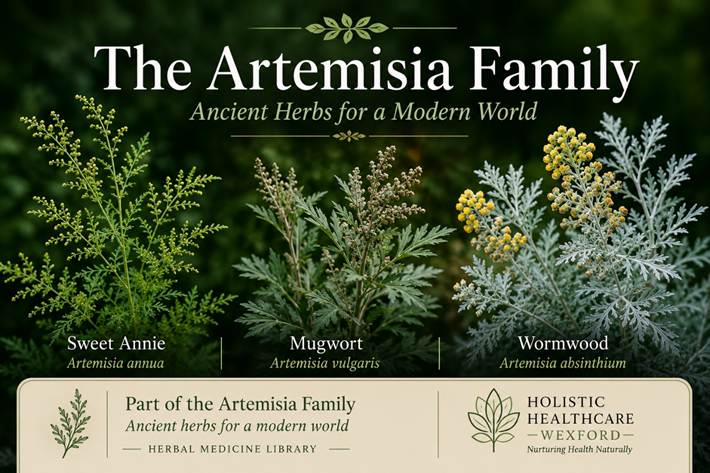
Part of the Holistic Healthcare Wexford Herbal Medicine Library
By Dr Catherine W. Dunne MSc.D., RGN (GPN), M.H.I.T.
Few botanical families have influenced herbal medicine as profoundly as the Artemisia genus.
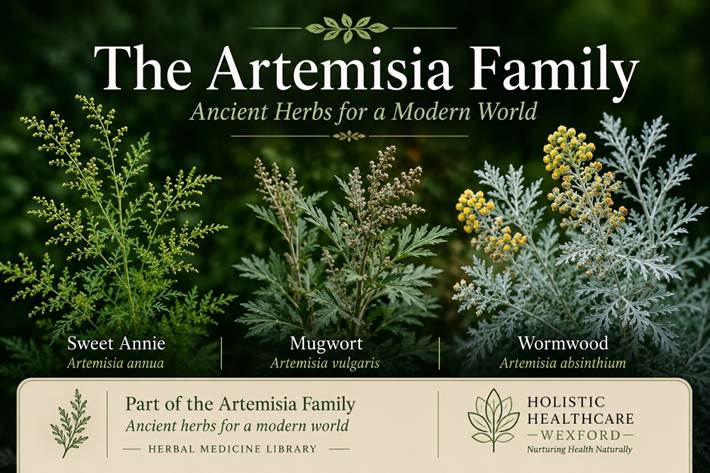
Comprising over 500 recognised species, members of the Artemisia family grow throughout Europe, Asia, Africa and North America. For thousands of years these aromatic herbs have occupied an important place in traditional herbal medicine, valued for supporting digestion, women’s health, fevers and protection against parasites.
Although many Artemisia species share a characteristic aromatic bitterness, each possesses its own unique chemistry, traditional uses and place within herbal medicine. Modern scientific research has highlighted important differences between species, making correct identification essential.
Whether known as Sweet Annie, Mugwort or Wormwood, these remarkable plants continue to bridge ancient herbal traditions with modern scientific investigation, reminding us that some of humanity’s oldest remedies still have much to teach us.
🌿 Sweet Annie (Artemisia annua)
Perhaps the best-known member of the family today, Sweet Annie gained worldwide recognition following the discovery of artemisinin, a compound that transformed the treatment of malaria and ultimately led to Professor Tu Youyou receiving the 2015 Nobel Prize in Physiology or Medicine.
Yet the story of Artemisia annua began long before modern laboratories. For centuries it was valued within Traditional Chinese Medicine, where careful observation laid the foundations for one of the most important medical discoveries of the twentieth century.
Today, researchers continue to investigate the plant’s remarkable chemistry, while herbalists continue to appreciate its long and fascinating history.
➡ Read: Sweet Annie (Artemisia annua)
🌿 Mugwort (Artemisia vulgaris)
Known for centuries as one of Europe’s oldest medicinal herbs, Mugwort has accompanied humanity through medicine, folklore and tradition.
Traditionally valued for supporting digestion, women’s health and nervous system wellbeing, it also became closely associated with moxibustion in Traditional Chinese Medicine. Beyond its medicinal uses, Mugwort has long been regarded as a plant of protection, travel and ceremony throughout many cultures.
Its story reminds us that medicinal plants often carry both practical and cultural significance.
➡ Read: Mugwort (Artemisia vulgaris)
🌿 Wormwood (Artemisia absinthium)
With its distinctive silver-grey foliage and intensely bitter taste, Wormwood has become one of Europe’s classic medicinal bitters.
Traditionally used to stimulate appetite and support healthy digestion, it later became famous through its association with absinthe. Yet its medicinal history stretches back thousands of years and extends far beyond that single chapter.
Today, Wormwood continues to be appreciated for its carefully controlled herbal use while recognising that preparations containing its essential oil require appropriate caution due to the presence of thujone.
➡ Read: Wormwood (Artemisia absinthium)
Why Learn About the Artemisia Family?
Although these herbs belong to the same botanical genus, they are not interchangeable.
Each species possesses its own unique chemistry, traditional applications and level of scientific evidence. Understanding these differences allows herbalists, healthcare professionals and home gardeners alike to appreciate each plant for its individual strengths while using them appropriately and responsibly.
Together, the Artemisia family reminds us that one botanical genus can contain an extraordinary diversity of medicinal plants, each contributing its own chapter to the long and continuing story of herbal medicine.
I hope you feel inspired to step outside, notice the remarkable plants growing around you and continue exploring the wonderful world of herbal medicine.
Look after your body, and it will help look after you.
Catherine

CWD | 12 July 2026 | Ireland
Holistic Healthcare Wexford
Integrative · Mindful · Patient-Centred
About the Author
Dr Catherine W. Dunne MSc.D. is a Registered General Nurse with over 37 years of clinical experience in primary care in Ireland. Alongside her work in General Practice Nursing, she is the founder of Holistic Healthcare Wexford and co-founder of Aumvedas Academy.
With a background that bridges conventional nursing, herbal medicine and holistic practice, Catherine has a particular interest in helping people understand the relationship between traditional botanical knowledge, modern scientific evidence and whole-person wellbeing.
Disclaimer
This article is for informational and educational purposes only and is not intended as medical advice. It does not replace consultation with a qualified healthcare professional. Patients should always seek appropriate medical guidance regarding their individual health needs and before making changes to treatment or care.

