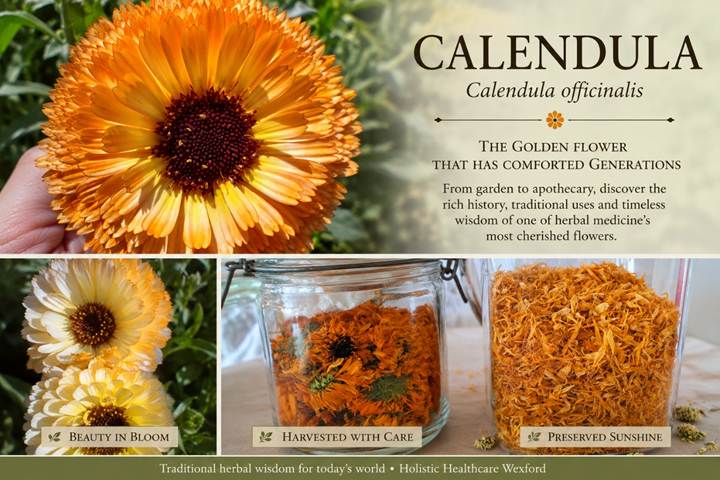
Calendula (Calendula officinalis)
The Golden Flower That Has Comforted Generations
Part of the Holistic Healthcare Wexford Herbal Medicine Library
By Dr Catherine W. Dunne MSc.D., RGN (GPN), M.H.I.T.
Few medicinal plants brighten both the garden and the apothecary quite like Calendula (Calendula officinalis).
With its brilliant golden-yellow and deep orange flowers, Calendula has delighted gardeners, herbalists and physicians for centuries. More than simply an ornamental plant, it has earned a respected place in traditional herbal medicine, where it has been valued for supporting the skin, soothing minor irritations and promoting the body’s natural healing processes.
Unlike some medicinal herbs that hide quietly amongst hedgerows and woodland paths, Calendula seems to celebrate being noticed.
Its cheerful flowers open with the morning sun and often close again towards evening, almost as though the plant itself follows the rhythm of the day.
Perhaps that is one reason generations have associated Calendula with warmth, comfort and restoration.
Today it remains one of the most widely cultivated medicinal flowers in the world, equally at home in cottage gardens, monastery gardens and modern herbal practices.
Its beauty captures the eye.
Its history captures the imagination.
A Flower Through History
The story of Calendula stretches back many centuries.
Native to southern Europe but now cultivated throughout much of the world, the plant became highly valued by ancient civilisations for both its beauty and its practical usefulness. The Romans admired its vibrant flowers, while medieval herbalists included Calendula amongst the essential plants grown in monastery physic gardens.
Its common name is believed to derive from the Latin word calendae, meaning “the first day of the month.”
Unlike many flowers that bloom for only a short season, Calendula often flowers repeatedly throughout the warmer months, giving the impression that it blooms with every passing month of the year.
This remarkable willingness to keep flowering made it a symbol of constancy, hope and renewal.
For herbalists, however, its greatest value lay not in symbolism but in its versatility.
The bright petals found their way into oils, ointments, creams, washes, teas and tinctures, becoming one of the most frequently used medicinal flowers in traditional European herbal medicine.
Meeting Calendula
Calendula is a member of the Asteraceae, or daisy family, although its flowers possess a richness and fullness that often distinguish it from its wild relatives.
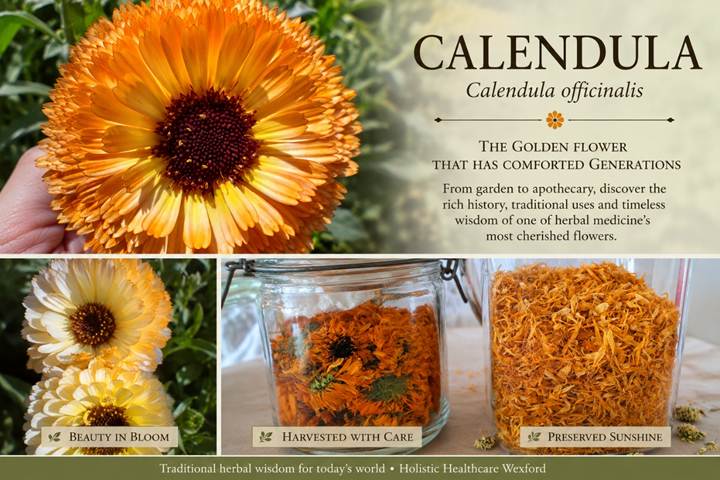
Depending on the variety, the blooms range from soft buttery yellow to vibrant orange and even deep apricot shades. Some varieties produce simple daisy-like flowers, while others develop densely layered double blooms that resemble miniature chrysanthemums.
Its bright green leaves are soft to the touch and slightly aromatic when gently crushed.
Throughout the growing season, Calendula rewards even modest care with an abundance of flowers, often continuing to bloom from late spring until the first frosts of autumn.
There is only one small secret.
The more flowers you harvest…
…the more flowers the plant seems determined to produce.
For generations, gardeners have smiled at this simple truth.
Calendula is never happier than when it is being picked.
Harvesting Sunshine
If there is one herb that teaches patience and generosity, it is Calendula.
Unlike many medicinal plants that offer only a brief harvesting season, Calendula seems almost eager to keep giving. The more flowers that are carefully picked, the more new blossoms appear, rewarding the gardener with an almost continuous display throughout the summer.
There is a quiet rhythm to harvesting Calendula.
Early in the morning, once the dew has lifted and the flowers have fully opened to the sun, each bloom is gently picked by hand. Some herbalists prefer to dry the entire flower head, while others carefully separate the petals before drying.
Both methods have their place.
The important thing is to preserve the flowers gently, allowing the warmth of summer to remain within them.
Spread thinly in a warm, well-ventilated place away from direct sunlight, the flowers slowly lose their moisture while retaining much of their remarkable colour.
Months later, opening a jar of dried Calendula petals is rather like opening a little piece of summer.
The brilliant oranges and golden yellows remain almost unchanged, carrying with them memories of warm gardens, buzzing bees and long sunny afternoons.
For many herbalists, that simple moment is one of the great pleasures of working with medicinal plants.
A Flower for the Skin
Perhaps no medicinal flower has earned a stronger reputation for supporting healthy skin than Calendula.
For generations it has been infused into oils, incorporated into creams, ointments, salves and balms, and applied wherever gentle support for the skin has traditionally been desired.
Its popularity is easy to understand.
Calendula is one of those rare herbs that seems equally at home in the family medicine cupboard as it is in the professional herbal dispensary.
Traditional herbalists have long appreciated its role in caring for dry, delicate or irritated skin. Infused oils prepared from the flower heads remain one of the most widely used preparations, often forming the foundation of many herbal skin products.
Today, Calendula continues to feature in countless natural skincare formulations throughout the world.
Its enduring popularity speaks for itself.
More Than a Skin Herb
Although Calendula is often thought of as a herb for the skin, its traditional uses extend far beyond external applications.
Historically, Calendula was also prepared as herbal infusions and tinctures, where it was valued for supporting the body’s natural healing processes and overall wellbeing.
Modern research has identified a rich collection of naturally occurring constituents within the flowers, including flavonoids, triterpenoids, carotenoids and essential oils. These compounds continue to attract scientific interest as researchers seek to understand the plant’s remarkable biological activity.
As with many medicinal herbs, however, centuries of traditional experience still exceed the amount of modern clinical research currently available.
This should not be viewed as a weakness.
Rather, it reflects the fact that many traditional medicinal plants are only now beginning to receive the scientific attention they deserve.
Growing Calendula
Few medicinal plants are as rewarding to grow.
Calendula asks for very little in return.
A sunny position, reasonably fertile soil and occasional watering during prolonged dry spells are usually all that is required.
Once established, the plants flower generously over many months, attracting bees, hoverflies and numerous other beneficial insects into the garden.
For many gardeners, Calendula serves a dual purpose.
It is both beautiful and useful.
The flowers brighten vegetable beds, cottage gardens and herb borders while quietly providing a continuous supply of fresh medicinal blooms throughout the growing season.
Perhaps that is one of the reasons Calendula has remained such a favourite for generations.
It asks for little.
Yet gives abundantly.
A Flower That Continues to Give
Some medicinal plants impress us with their complexity.
Others earn our admiration through their quiet dependability.
Calendula belongs firmly in the second group.
It asks for little more than sunshine, a little space to grow and the occasional watering during dry weather. In return, it offers months of vibrant flowers, attracts pollinating insects, brightens the garden and provides one of herbal medicine’s most versatile medicinal flowers.
Perhaps that is why Calendula has remained so deeply loved throughout history.
Not because it is rare.
Not because it is difficult to cultivate.
But because it is generous.
Every flower picked encourages another to bloom.
Every harvest reminds us that nature often responds to care with abundance.
There is something wonderfully reassuring about that.
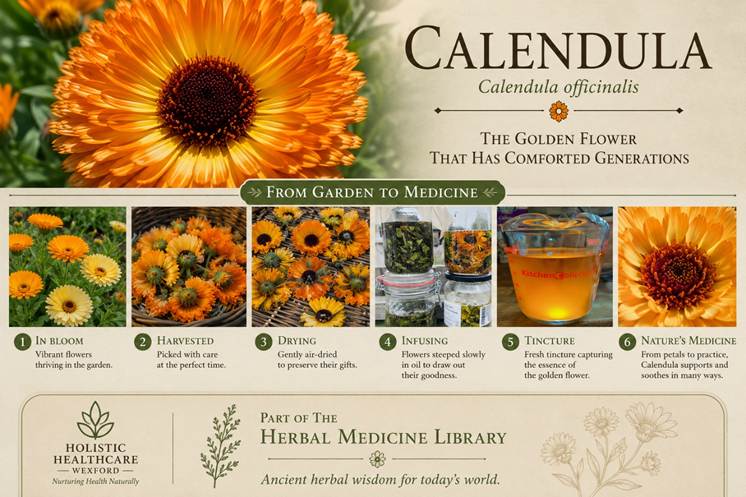
From Garden to Medicine
One of the greatest pleasures of growing medicinal herbs is witnessing their complete journey.
Calendula begins as a cheerful garden flower, is harvested by hand, carefully dried and then transformed into oils, tinctures, teas and topical preparations. Every stage has its own purpose, and every stage connects us a little more closely with the remarkable plants growing around us.
Catherine’s Herbal Notes
Harvest: June–September
Parts used: Flowers (fresh or dried)
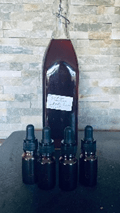
Favourite preparations: Infused oil and tincture
Grown in: My medicinal herb garden, County Wexford, Ireland
Calendula never seems to tire of giving. The more flowers I harvest, the more generously it blooms. Opening a jar of dried petals in winter is rather like opening a little piece of summer.
Final Thoughts
Every herb has its own personality.
Some command attention through their strength.
Others through their mystery.
Calendula does neither.
Instead, it quietly earns our trust.
Its bright flowers have accompanied herbalists, gardeners and families for centuries, bringing colour to the garden and comfort to the home. Long before modern skincare products lined pharmacy shelves, Calendula had already found its place in oils, creams, salves and herbal preparations made with patience and care.
Today, science continues to explore the remarkable chemistry contained within these golden flowers, while gardeners continue to sow the same familiar seeds each spring, knowing they will once again be rewarded with months of cheerful blooms.
Perhaps that is Calendula’s greatest lesson.
Sometimes the simplest plants become the most faithful companions.
They ask us to slow down.
To notice the changing seasons.
To appreciate beauty alongside usefulness.
And to remember that some of nature’s finest medicines have been growing quietly in our gardens all along.
I hope you feel inspired to step outside, notice the remarkable plants growing around you and continue exploring the wonderful world of herbal medicine.
Look after your body, and it will help look after you.
Catherine

CWD | 17 July 2026 | Ireland
Holistic Healthcare Wexford
Integrative · Mindful · Patient-Centred
About the Author
Dr Catherine W. Dunne MSc.D., RGN (GPN), M.H.I.T. is a Registered General Nurse with over 37 years of clinical experience in primary care in Ireland. Alongside her work in General Practice Nursing, she is the founder of Holistic Healthcare Wexford and co-founder of Aumvedas Academy.
With a background that bridges conventional nursing, herbal medicine and holistic practice, Catherine has a particular interest in helping people understand the relationship between traditional botanical knowledge, modern scientific evidence and whole-person wellbeing.
Through a combination of clinical expertise and holistic support, she is passionate about empowering people to make informed choices about their health while respecting both evidence-based medicine and the long tradition of herbal practice.
Based in Wexford, Ireland.
Disclaimer
This article is intended for informational and educational purposes only and should not be considered medical advice. It is not a substitute for consultation with a qualified healthcare professional. Always seek appropriate medical guidance regarding your individual health needs before making changes to your treatment, medication or healthcare plan.