Emotional Wisdom: Have We Forgotten How to Listen to the Body?
By Dr Catherine W. Dunne, MSc.D., RGN (GPN), M.H.I.T., I.R.E.T.
Ancient observations, modern physiology and the Daoist art of paying attention
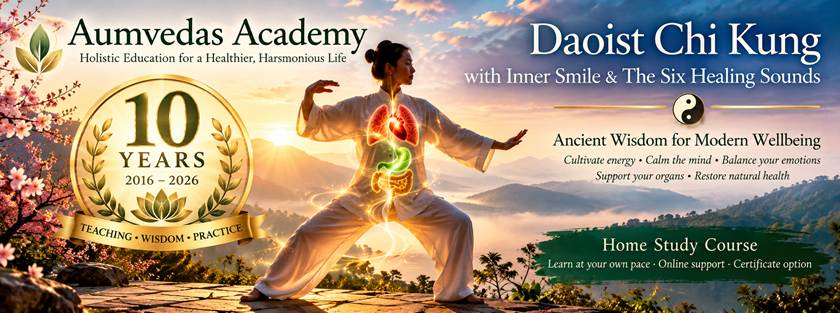
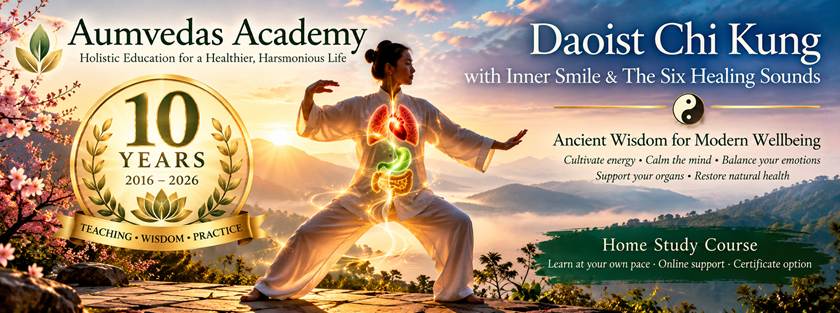
Featured image: Aumvedas Academy – Daoist Chi Kung, 10 Years (2016–2026)
For generations, we have become accustomed to thinking about the body in parts. The heart belongs to cardiology. The stomach belongs to gastroenterology. The kidneys belong to nephrology. Our emotions, meanwhile, are often placed into an entirely different box.
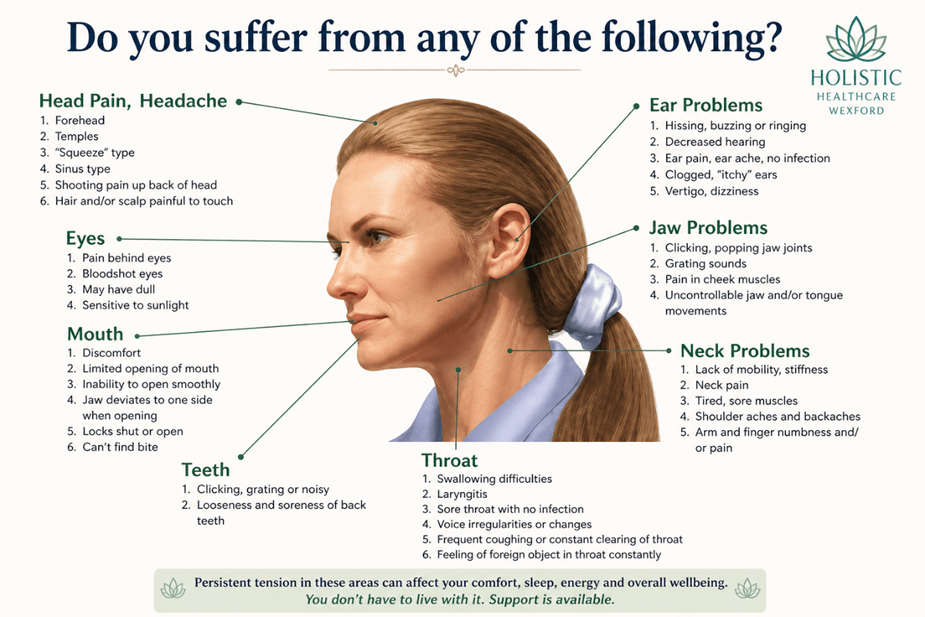
Yet anyone who has experienced fear, grief, anger or anxiety knows that emotions are not experienced only in the mind. Fear can make the heart race. Anxiety can tie the stomach into knots. Grief can alter our breathing. Anger can produce heat, tension and a very physical sense of agitation.
Our everyday language still carries this understanding. We speak of something being gut-wrenching. We are sick with worry. We need to get something off our chest. We feel butterflies in our stomach. Something makes our blood boil.
Perhaps our bodies and emotions were never as separate as modern life has encouraged us to believe.
An Older Understanding of Health
Long before laboratories, imaging and modern diagnostic medicine, people had to become extraordinarily careful observers. They watched the seasons, understood local plants, observed changes in the body and developed cultural explanations for relationships between emotion, environment, lifestyle and illness.
European folk healers, wise women, herbalists, traditional medicine people and other healing traditions did not all share one universal organ-emotion map. Their beliefs and practices differed greatly across place and time. What is striking, however, is how often older systems considered the person in a broader context: body, mind, environment, community and, in many traditions, spirituality.
Some of that knowledge survived. Some evolved. Some was rejected as medicine changed. And some simply faded from everyday memory.
The Daoist Understanding of Emotional Wisdom
Daoist and traditional Chinese medical traditions developed a particularly detailed framework linking the Five Elements, internal organ systems and emotional qualities. Classical Chinese medical literature has discussed relationships between emotion and the five Zang organ systems for more than two millennia. Importantly, these traditional ‘organs’ are not identical to the anatomical organs of modern Western medicine; they belong to a broader functional system that includes physiological and psychological relationships [1–3].
Within the Aumvedas Academy course material, the Inner Smile and Six Healing Sounds focus on five principal organ systems: heart, lungs, kidneys, liver/gallbladder and stomach/spleen. The course explores traditional associations between these systems and emotional qualities, together with the idea of transforming difficult emotional energy into corresponding virtues.
| Traditional organ/system | Challenging emotional qualities | Cultivated qualities |
| Heart | Arrogance, hate, impatience | Kindness, love, joy |
| Lungs | Sadness, depression/grief | Courage, righteousness/strength |
| Kidneys | Fear | Gentleness, kindness/wisdom |
| Liver / gallbladder | Anger | Generosity, kindness/forgiveness |
| Stomach / spleen | Worry, anxiety | Openness, fairness/trust |
The point is not that a healthy person should never feel anger, fear, grief or worry. These are human emotions. The traditional practice is concerned with awareness, balance and transformation rather than simply suppressing what we feel.
Instead of asking, “How do I get rid of this emotion?” we might ask, “What is this emotion telling me, where do I experience it in my body, and what happens when it becomes persistent?”
When Emotion Becomes Physical
Here, traditional observation and modern physiology can have an interesting conversation without pretending that they are the same medical system.
Modern medicine does not establish that anger simply causes liver disease, that grief causes lung disease, or that fear directly causes kidney disease. Those statements would turn a traditional symbolic and functional framework into a modern biomedical claim it cannot support.
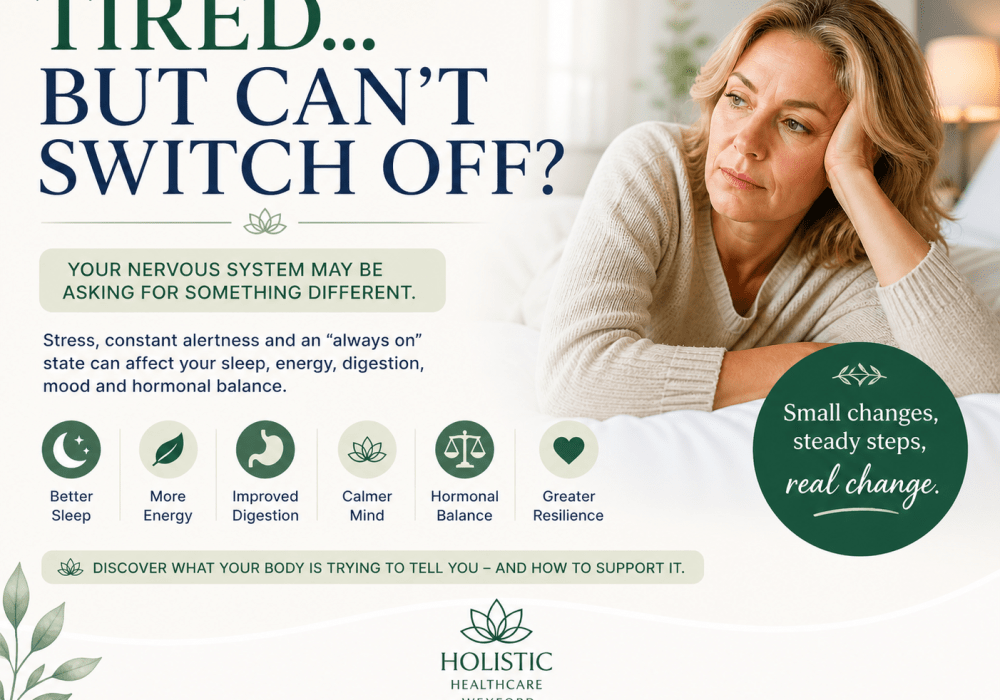
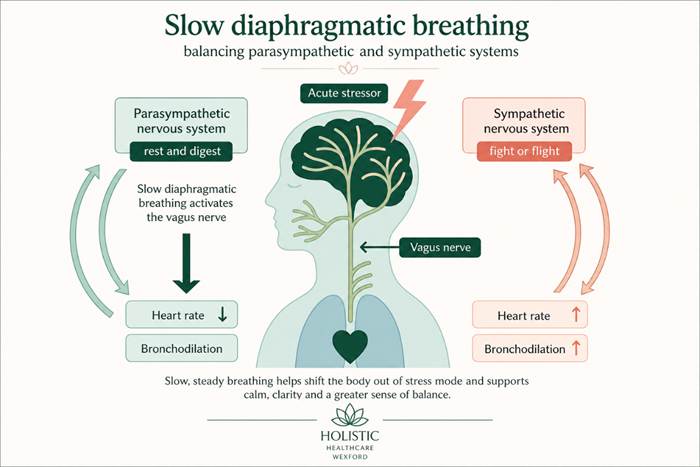
What modern physiology does show very clearly is that stress is physical as well as emotional. During the stress response, hormones are released, heart rate and breathing rate rise, blood pressure can increase, muscles tense and other body functions change. Long-term or chronic stress may contribute to or worsen problems including digestive and sleep disorders, and prolonged stress responses are associated with wider neuroendocrine, metabolic, immune and inflammatory effects [4,5].
So the useful bridge is not ‘one emotion equals one disease’. It is the recognition that emotional experience can produce genuine bodily responses, and that persistent stress can matter to health.
That does not mean every illness has an emotional cause. It means emotional wellbeing deserves a place in our understanding of physical wellbeing.
Have We Lost the Art of Listening?
Modern healthcare can measure the body with extraordinary precision: blood pressure, glucose, cholesterol, hormones, kidney function, liver enzymes, oxygen saturation and countless other markers. Those advances matter enormously.
Traditional practices should never be used as a reason to ignore persistent symptoms, delay medical assessment or replace appropriate investigation and treatment.
But alongside measuring the body, there may still be value in listening to it.
What happens in your body when you are frightened? Where do you feel grief? What changes when you have worried for weeks? What does anger physically feel like? Do you notice those signals, or have you become accustomed to overriding them?
These are simple questions. They can also be revealing.
Rediscovering Emotional Wisdom
Daoist Chi Kung contains practices intended to cultivate this internal awareness. Among them are the Inner Smile and the Six Healing Sounds. Within the traditional framework, these practices work with attention, breath, sound, movement, the organ systems and emotional qualities.
They sit within a much larger body of teaching that includes Yin and Yang, the Five Elements, Chi, organ relationships and traditional daily cycles.
And that is where I am deliberately going to stop.
A centuries-old system deserves rather more than a five-minute internet summary.
Celebrating 10 Years of Aumvedas Academy
2026 marks ten years of Aumvedas Academy: 2016–2026.
For a decade, the Academy has provided home-study education in holistic and traditional approaches to wellbeing, giving students the opportunity to explore these subjects in considerably greater depth than is possible in a short article.
As part of our tenth-anniversary year, I am delighted to bring renewed attention to one of our established home-study programmes:
DAOIST CHI KUNG
with Inner Smile & The Six Healing Sounds
The course explores Chi, Yin and Yang, the Five Elements, traditional organ-emotion relationships, the Inner Smile, the Six Healing Sounds, the 24-hour Chi cycle and practical exercises. Students study at home and at their own pace, followed by online examination through Aumvedas Academy.
Course Fee: €190
Final Thoughts
Perhaps emotional wisdom is not something entirely new that we need to discover. Perhaps part of it is something very old that we need to remember.
Our ancestors did not have today’s laboratories, scanners or understanding of physiology, but generations of human beings carefully observed relationships between how we live, how we feel and how the body responds.
Modern medicine gives us extraordinary tools for understanding health and disease. Traditional practices can offer another kind of tool: an invitation to pay attention. The two need not be enemies.
Sometimes the first step is simply learning to listen again.
I hope you feel inspired to become a little more curious about the conversations taking place between your emotions and your physical body, and perhaps to explore some of the traditional wisdom that has sought to understand that relationship for centuries.
Look after your body, and it will help look after you.
Catherine

CWD | 03 Oct 2026 | Ireland
Holistic Healthcare Wexford
Integrative · Mindful · Patient-Centred
References
- Traditional Chinese Medicine and Clinical Pharmacology. Frontiers in Pharmacology / PMC. Overview of Yin-Yang, Five Elements and organ correspondences in the Huang Di Nei Jing.
- An East Meets West Approach to the Understanding of Emotion Dysregulation in Depression: From Perspective to Scientific Evidence. Frontiers in Psychology / PMC. Discussion of the traditional five-viscera emotion framework and its distinction from Western anatomical organ concepts.
- Emotion-Focused Therapy: A Perspective From Traditional Chinese Medicine. Integrative Psychological and Behavioural Science / PMC. Historical discussion of emotion in the Huangdi Neijing and later Chinese medical case traditions.
- National Center for Complementary and Integrative Health (NCCIH). Stress. National Institutes of Health. Overview of the physiological stress response and health effects of chronic stress.
- National Center for Complementary and Integrative Health (NCCIH). Press Reset on Stress. National Institutes of Health. Summary of chronic stress effects on sleep, metabolism, immune regulation and inflammation.
- Aumvedas Academy. DAOIST Chi Kung with Inner Smile and The 6 Healing Sounds. Home-study course manual. Course material used for the descriptions of the Aumvedas programme and its traditional organ-emotion teaching.
About the Author
Dr Catherine W. Dunne MSc.D. is a Registered General Nurse with over 37 years of clinical experience, including extensive experience in primary care and General Practice Nursing in Ireland. Alongside her work in General Practice Nursing, she is the founder of Holistic Healthcare Wexford and co-founder of Aumvedas Academy.
With a background that bridges conventional medicine and holistic practice, Catherine has a particular interest in the area where patients are often told “everything is normal,” yet still feel unwell. Her work focuses on helping people understand what their body is communicating, especially in relation to energy, stress, metabolic function, and recovery.
Through a combination of clinical knowledge and holistic support, she works with individuals to restore balance, improve resilience, and support long-term wellbeing.
Based in Wexford, Ireland.
Disclaimer:
This article is for informational and educational purposes only and is not intended as medical advice. It does not replace consultation with a qualified healthcare professional. Patients should always seek appropriate medical guidance regarding their individual health needs and before making changes to treatment or care.
AI-Disclaimer:
About the images: Unless otherwise stated, the photographs used throughout this library are the author’s own. AI-assisted design tools may be used to create educational layouts, improve presentation, and incorporate Holistic Healthcare Wexford branding. The botanical content and educational purpose remain those of the author.