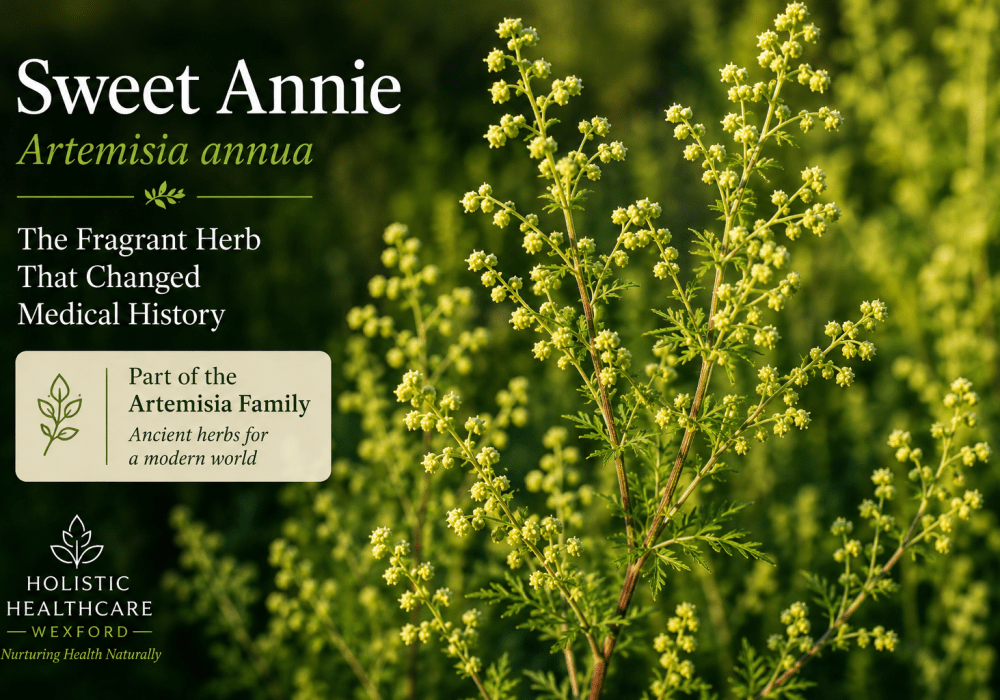
Sweet Wormwood (Artemisia annua)
Sweet Annie – The Fragrant Herb That Changed Medical History
Part of the Holistic Healthcare Wexford Herbal Medicine Library
By Dr Catherine W. Dunne MSc.D., RGN (GPN), M.H.I.T.
Some medicinal plants quietly remain within the pages of old herbal books, treasured by herbalists yet largely unknown to the wider world.
Others change the course of medical history.
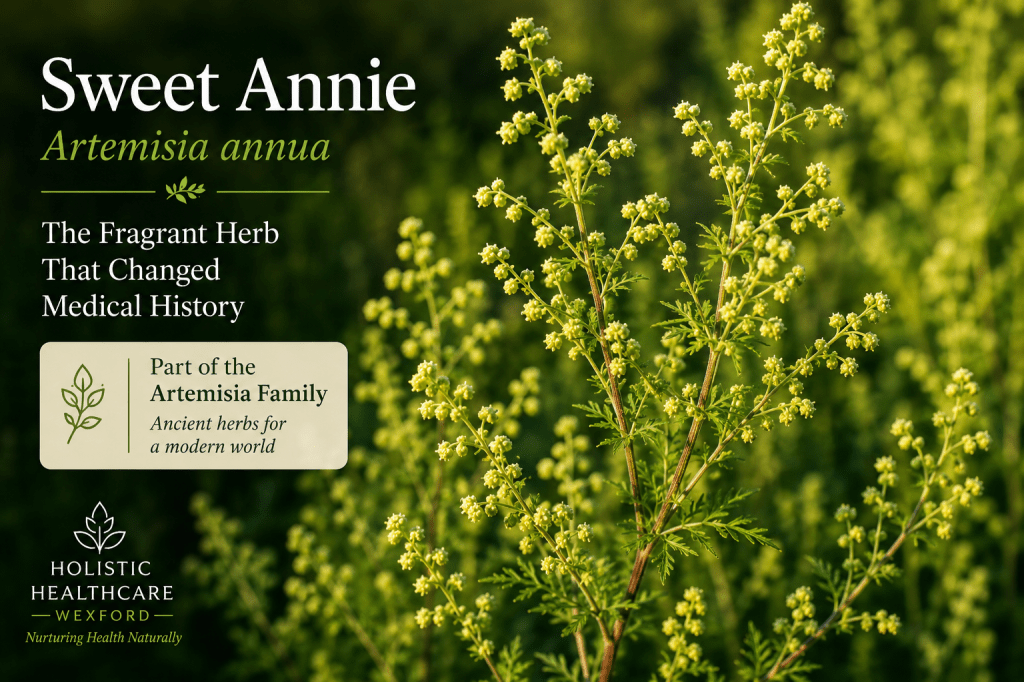
Sweet Wormwood (Artemisia annua), affectionately known to many gardeners as Sweet Annie, belongs firmly in the second category.
At first glance, there is little to suggest this graceful annual herb is anything extraordinary. Its delicate, fern-like foliage sways gently in the summer breeze, releasing a fresh aromatic fragrance whenever the leaves are brushed by a passing hand. Growing to almost two metres in height, with thousands of tiny yellow flowers appearing towards late summer, it is as beautiful as it is distinctive.
Many people grow Sweet Annie simply because they enjoy its appearance and fragrance.
Herbalists, however, have admired it for centuries for very different reasons.
Native to temperate regions of Asia, particularly China, Sweet Wormwood has been valued in traditional herbal medicine for more than two thousand years. Known in Traditional Chinese Medicine as Qinghao (青蒿), it was carefully recorded in ancient medical texts long before anyone understood parasites, pharmacology or the remarkable chemistry hidden within its delicate leaves.
Centuries later, scientists studying those ancient writings isolated a naturally occurring compound that would revolutionise the treatment of malaria and ultimately save millions of lives throughout the world. That discovery earned Professor Tu Youyou the 2015 Nobel Prize in Physiology or Medicine and remains one of the greatest examples of traditional herbal knowledge inspiring modern scientific discovery.
Yet Sweet Annie is far more than the story of one remarkable discovery.
It is the story of curiosity.
It reminds us that the observations made by generations of herbalists can, when explored carefully and objectively, open entirely new doors for scientific understanding. Traditional knowledge and modern medicine do not always stand on opposite sides of the fence. Sometimes they simply begin their journeys from different directions before meeting in the middle.
Today, Sweet Wormwood continues to attract worldwide interest. Researchers are investigating its chemistry, pharmacology and potential applications across a wide range of medical fields, while gardeners continue to grow it for its beauty, herbalists continue to value its long history, and nature lovers simply appreciate it for the elegant plant that it is.
Perhaps that is what makes Sweet Annie so fascinating.
It invites us to look more closely.
A Plant of Many Names
Depending on where you live, this remarkable herb may be known by several different names.
- Sweet Annie
- Sweet Wormwood
- Annual Wormwood
- Qinghao (Traditional Chinese Medicine)
- Artemisia annua (Botanical name)
Although these names all refer to the same plant, confusion often arises because Sweet Annie belongs to one of the largest and most fascinating genera in the plant kingdom.
The Artemisia genus contains well over five hundred recognised species growing throughout Europe, Asia, Africa and North America. While many share their characteristic aromatic fragrance and bitter principles, each possesses its own unique chemistry, traditional uses and personality.
Among the best known are:
- Sweet Wormwood (Artemisia annua)
- Mugwort (Artemisia vulgaris)
- Wormwood (Artemisia absinthium)
- Tarragon (Artemisia dracunculus)
Although closely related botanically, these herbs are by no means interchangeable. Each has earned its own place within traditional herbal medicine and modern research, and understanding those differences is one of the foundations of safe herbal practice.
Meeting Sweet Annie
One of the pleasures of growing Sweet Annie is that it engages almost every one of the senses.
Long before harvest time, the plant catches the eye with its soft, feathery foliage, giving it an almost cloud-like appearance in the herb garden. On warm summer days, simply brushing past the leaves releases an unmistakable aromatic scent—fresh, clean and pleasantly herbaceous without the intense bitterness associated with its close relative, Wormwood.
As summer progresses, the plant continues its rapid growth, often reaching between one and two metres in height before producing masses of tiny yellow flower heads. Although individually insignificant, together they create a delicate haze above the foliage that adds to the plant’s natural elegance.
It is perhaps this combination of beauty and usefulness that has allowed Sweet Annie to remain a favourite among gardeners and herbalists alike. Some grow it purely as an ornamental. Others value its fragrance in dried arrangements. Herbalists, meanwhile, recognise it as one of the most historically significant medicinal plants in the world.
Few plants manage to combine all three so effortlessly.
An Ancient Herb with a Remarkable History
Long before microscopes, modern laboratories or clinical trials existed, physicians relied upon one of their greatest diagnostic tools: careful observation.
Over countless generations, they watched which plants appeared to help particular illnesses, how they should be prepared and, equally importantly, when they failed to produce the desired effect. Their observations were carefully recorded, refined and passed from one generation to the next.
Sweet Wormwood was one such plant.
Its earliest recorded use dates back over two thousand years within Traditional Chinese Medicine, where it became known as Qinghao (青蒿). Ancient Chinese physicians recognised the herb as particularly valuable for conditions associated with recurrent fevers and heat-related illnesses. Although they could not explain why it worked, they understood that careful preparation influenced its effectiveness.
One of the earliest written descriptions appears in the work of the fourth-century physician Ge Hong (284–364 AD), whose medical text Emergency Prescriptions Kept Up One’s Sleeve described extracting the fresh herb rather than subjecting it to prolonged boiling. It was a seemingly simple instruction that would prove remarkably important many centuries later.
Like many traditional healers throughout history, Ge Hong was recording practical experience rather than scientific theory. His writings remind us that careful observation has always been one of medicine’s greatest strengths.
Today, we often think of scientific discovery as beginning in the laboratory. Yet many of the medicines we now take for granted first began as observations made by people who simply paid close attention to the natural world around them.
Sweet Annie is one of the finest examples of that journey.
From Ancient Wisdom to Modern Medicine
For centuries, Sweet Wormwood remained largely confined to traditional Chinese medicine, appreciated by herbal practitioners but relatively unknown elsewhere in the world.
That changed dramatically during the twentieth century.
In the late 1960s and early 1970s, scientists in China began searching for new treatments for malaria, a disease responsible for countless deaths across many parts of the world. Existing medicines were becoming less effective as resistance developed, creating an urgent need for new approaches.
Rather than looking only towards synthetic chemistry, researchers turned their attention to traditional medical texts.
Among the many plants described, Qinghao attracted particular interest.
Inspired by the writings of Ge Hong, researchers reconsidered how the herb should be prepared. Earlier extraction methods had produced disappointing results, but by using lower temperatures, they were able to isolate a compound that retained its biological activity.
That compound became known as artemisinin.
The discovery transformed malaria treatment and has since saved millions of lives worldwide. In recognition of this extraordinary achievement, Professor Tu Youyou was awarded the Nobel Prize in Physiology or Medicine in 2015.
It remains one of the most celebrated examples of traditional herbal knowledge contributing directly to modern medicine.
Perhaps the greatest lesson from this story is not simply that one plant contained a remarkable compound.
It is that curiosity, open-mindedness and respect for historical knowledge can sometimes lead to discoveries that change the world.
More Than Artemisinin
Although Sweet Wormwood is now almost synonymous with artemisinin, the plant itself is far more complex than a single chemical constituent.
Like many medicinal herbs, Artemisia annua contains hundreds of naturally occurring compounds that work together to create its unique chemical profile. These include flavonoids, essential oils, phenolic compounds, coumarins and numerous other phytochemicals, many of which continue to be investigated by researchers around the world.
This is an important distinction.
When herbalists speak of Sweet Annie, they are usually referring to the whole plant, with its naturally balanced mixture of constituents.
When physicians prescribe artemisinin-based medicines, they are prescribing carefully purified pharmaceutical preparations that have undergone rigorous testing for specific medical conditions.
Both have their place.
Understanding the difference allows us to appreciate the remarkable complexity of medicinal plants while recognising the importance of evidence-based medicine and safe clinical practice.
A Herb of Extraordinary Complexity
One of the greatest mistakes we can make when studying medicinal plants is to imagine that they owe their reputation to a single active ingredient.
Nature rarely works that way.
Sweet Wormwood is a perfect example.
Although artemisinin became the compound that brought worldwide recognition to Artemisia annua, it represents only one part of an extraordinarily complex plant. Within its leaves, stems and flowers are hundreds of naturally occurring phytochemicals that together create the plant’s unique character.
Among these are flavonoids, essential oils, coumarins, phenolic compounds and sesquiterpene lactones, each contributing in different ways to the plant’s chemistry. Some possess antioxidant properties, others contribute to the plant’s aroma, while many continue to be investigated for their biological activity.
This complexity is one of the reasons herbal medicine remains such a fascinating field of study.
Rather than viewing a medicinal herb as a single chemical, herbalists have traditionally regarded the whole plant as a living partnership of naturally occurring constituents, each complementing the others in ways we are only beginning to understand.
Modern science continues to unravel these relationships, yet many questions remain unanswered.
Perhaps that is part of Sweet Annie’s enduring appeal.
Even after centuries of use and decades of intensive scientific investigation, this graceful herb continues to reveal new secrets.
Traditional Herbal Uses
For generations, Sweet Wormwood has occupied an important place in traditional herbal medicine, particularly throughout China and neighbouring regions of Asia.
Historically, it was primarily valued as a cooling herb. Traditional practitioners associated it with conditions characterised by heat, particularly recurrent fevers and summer illnesses. Over time its use expanded into a variety of traditional preparations, each reflecting the medical understanding of the period.
Beyond its historical association with fevers, Sweet Annie has also been used traditionally to support digestion, encourage healthy liver function and promote general wellbeing during periods of convalescence.
As with many traditional herbal medicines, these uses developed through centuries of observation rather than controlled scientific studies. Some have since attracted modern research interest, while others remain part of traditional practice with limited clinical evidence available.
This distinction is important.
Traditional use provides valuable historical knowledge, but it does not automatically confirm effectiveness for every condition. Likewise, the absence of modern research does not necessarily mean that traditional observations hold no value. Both perspectives contribute to our understanding, provided they are approached with curiosity, balance and scientific honesty.
Sweet Annie in Today’s Herb Garden
Despite its remarkable medical history, Sweet Annie remains an exceptionally rewarding plant to grow.
It is an annual that thrives in full sun and well-drained soil, often reaching impressive heights during a single growing season. Once established, its finely divided foliage creates an airy backdrop within the herb garden, while the delicate yellow flower heads provide interest well into late summer.
Many gardeners value the plant simply for its ornamental beauty.
Others appreciate its wonderfully aromatic foliage, which releases its distinctive fragrance whenever the leaves are gently touched. Even after drying, the stems retain much of their pleasant scent, making Sweet Annie a favourite for wreaths, dried flower arrangements and herbal displays.
For herbalists, however, there is something especially satisfying about growing a plant whose story spans more than two thousand years. Caring for Sweet Annie offers a quiet reminder that many of today’s scientific discoveries first began with someone cultivating, observing and respecting the natural world.
Respecting the Plant
Sweet Annie has undoubtedly earned its place among history’s most important medicinal herbs.
Its journey from ancient Chinese medicine to one of the world’s most significant pharmaceutical discoveries is remarkable, yet that should not tempt us to exaggerate its role or overlook the need for careful scientific evaluation.
Like every medicinal plant, Sweet Annie deserves both respect and perspective.
It reminds us that nature still has much to teach us, but it also reminds us that good healthcare is built upon careful observation, thoughtful research and the willingness to distinguish established evidence from emerging possibilities.
Perhaps that is the greatest lesson this elegant herb has to offer.
Not that it holds all the answers.
But that curiosity, patience and open-minded enquiry remain among the most valuable tools in both herbal medicine and modern healthcare.
Final Thoughts
Some plants become famous because of folklore.
Others because of scientific discovery.
Sweet Annie has earned its reputation through both.
For more than two thousand years, it has quietly accompanied humanity’s search for better health. From the pages of ancient Chinese medical texts to modern laboratories, it has demonstrated that traditional knowledge and scientific enquiry need not be opposing forces. Instead, they can complement one another, each adding another piece to the larger picture.
Whether you grow it for its beauty, admire it for its history, or simply enjoy learning about the remarkable plants that surround us, Sweet Wormwood reminds us that even the most unassuming herb may have an extraordinary story waiting to be told.
I hope you feel inspired. Look after your body, and it will keep you healthy.
Catherine

CWD | 12 July 2026 | Ireland
Holistic Healthcare Wexford
Integrative · Mindful · Patient-Centred
About the Author
Dr Catherine W. Dunne MSc.D. is a Registered General Nurse with over 37 years of clinical experience in primary care in Ireland. Alongside her work in General Practice Nursing, she is the founder of Holistic Healthcare Wexford and co-founder of Aumvedas Academy.
With a background that bridges conventional medicine, herbal medicine and holistic practice, Catherine has a particular interest in patients who are often told, “everything is normal,” yet still feel unwell. Her work focuses on helping people better understand what their body is communicating, particularly in relation to nutrition, herbal medicine, stress, metabolic function, recovery and long-term wellbeing.
Through a combination of clinical knowledge and holistic support, she is passionate about empowering people to make informed choices about their health while respecting both evidence-based medicine and the long tradition of herbal practice.
Based in Wexford, Ireland.
Disclaimer
This article is intended for informational and educational purposes only and should not be considered medical advice. It is not a substitute for consultation with a qualified healthcare professional. Always seek appropriate medical guidance regarding your individual health needs before making changes to your treatment, medication or healthcare plan.
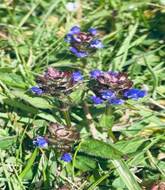
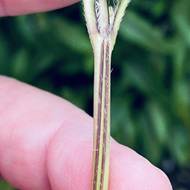
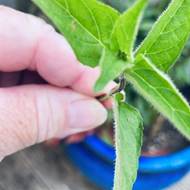
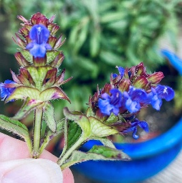
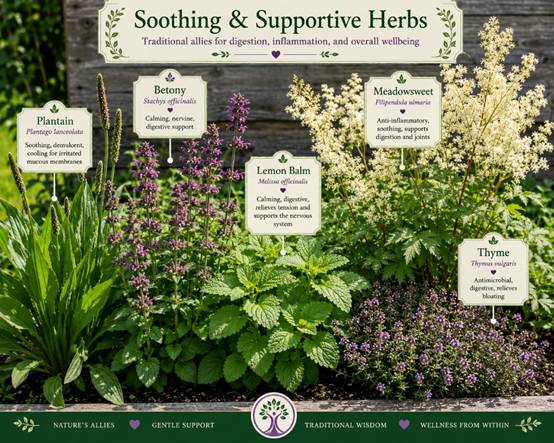
 combines beautifully with apple cider vinegar and honey.