Beyond the Eighteenth Level: My Reiki Journey Through Forgiveness and Gratitude
From a family introduction to Reiki, through decades of learning and practice, to the creation of Reiki Grandmaster Levels 19 and 20.
By Dr Catherine W. Dunne, MSc.D., RGN (GPN), M.H.I.T., I.R.E.T.
A Journey That Began Long Before Certificates
My journey with Reiki began in a rather unconventional way.
It did not begin with an advertised weekend workshop, a formal training programme or a certificate presented at the end of a course.
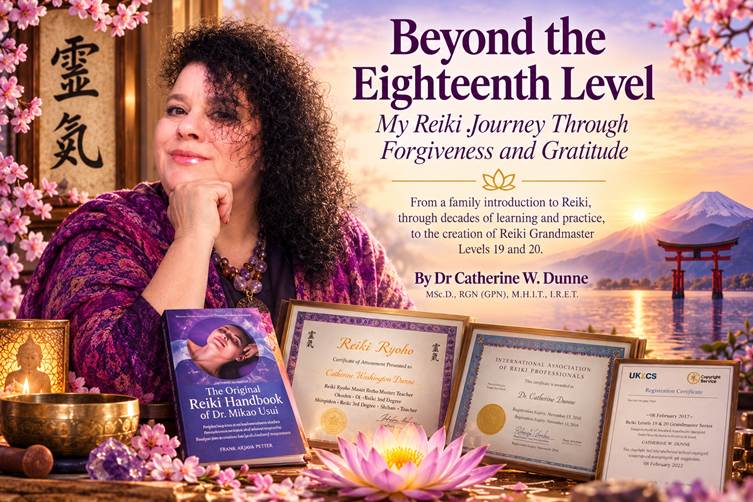
It began within my own family.
In the early 1950s, my stepfather, who was originally from Ghana, received a sponsored opportunity to study medicine in Moscow. During his time there, he became acquainted with a Japanese medical student who introduced him to Reiki and taught him the practice.
Years later, my stepfather passed that knowledge on to me.
There were no elaborate discussions about lineage, registration numbers or professional associations. What mattered was the teaching itself, the practical experience and the understanding passed from one person to another.
I did not appreciate at the time how unusual this introduction would later appear within the increasingly formalised Western Reiki community.
For me, Reiki was already familiar long before I encountered the modern systems of training and certification.
Dublin, 1996: A Familiar Practice Under a Familiar Name
In 1996, while in Dublin, I met another Reiki practitioner who introduced me to the work of William Lee Rand.
She knew a Reiki Master in Dublin City who had trained under him.
As I became acquainted with the Reiki being taught within these more formally organised circles, I recognised much of what I had already learnt through my stepfather.
It was an interesting moment.
Here was a practice I had known through family teaching, now presented within a structured system of levels, attunements and documented lineages.
I was curious to learn more.
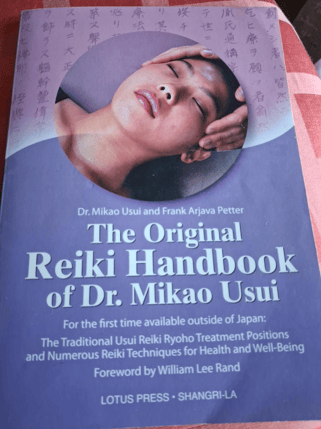
Over the following years, I continued studying Reiki and exploring its Japanese origins. Around the turn of the millennium, I became acquainted with The Original Reiki Handbook of Dr Mikao Usui, compiled by Frank Arjava Petter, and continued following the work of William Lee Rand.
I was particularly interested in traditional Japanese Reiki techniques, including Byosen.
Byosen: Listening Through the Hands
Byosen is a traditional Reiki practice involving attentive observation of sensations experienced through the hands during treatment.
Practitioners may describe sensations such as warmth, tingling, pulsation, heaviness or other changes in perception.
I had incorporated Byosen into my own Reiki practice from around 2000.
Recently, I came across a social media post presenting a step-by-step introduction to Byosen. I smiled to myself.
Here was a technique I had practised for approximately twenty-six years, appearing in my feed as an educational discovery!
Of course, techniques are continually introduced to new generations of practitioners. What is familiar to one person may be entirely new to another.
Nevertheless, it reminded me how much the public presentation of Reiki has changed over the years.
And it prompted me to reflect upon my own journey.
When Experience Was Not Enough: The Question of Lineage
As Reiki became increasingly organised within professional associations, formal qualifications and documented teaching lineages became important for registration.
This presented an interesting difficulty for someone with my background.
My original Reiki teaching had come through my stepfather, whose knowledge had been passed on by a Japanese medical student in Moscow decades earlier.
There was no documentary lineage available for me to produce.
That did not erase what I had learnt or the years I had spent practising. But it did mean that, to meet the requirements of professional registration, I needed recognised documentation.
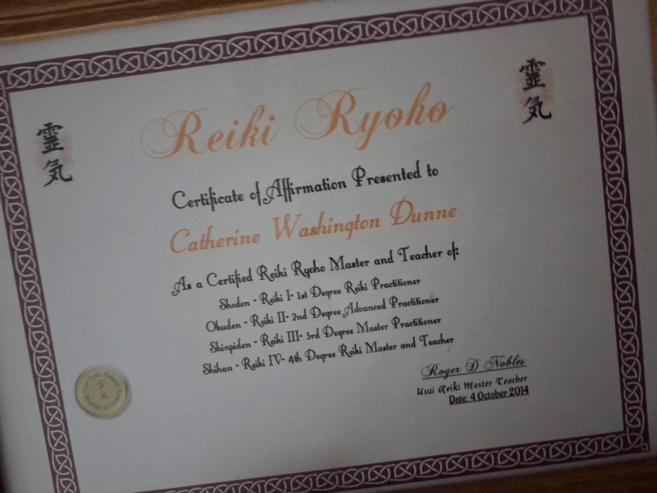
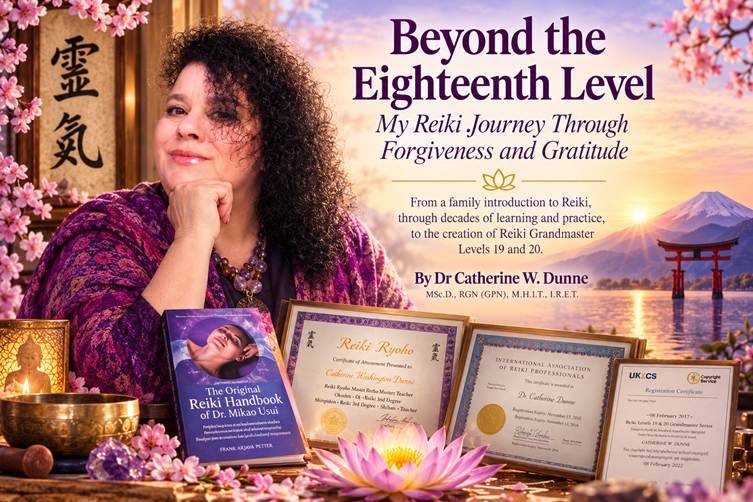
In 2014, I obtained Reiki Ryoho Master and Teacher certification through Roger D. Nobles.
My certificate, dated 4 December 2014, records the Shoden, Okuden, Shinpiden and Shihan stages of Reiki training.
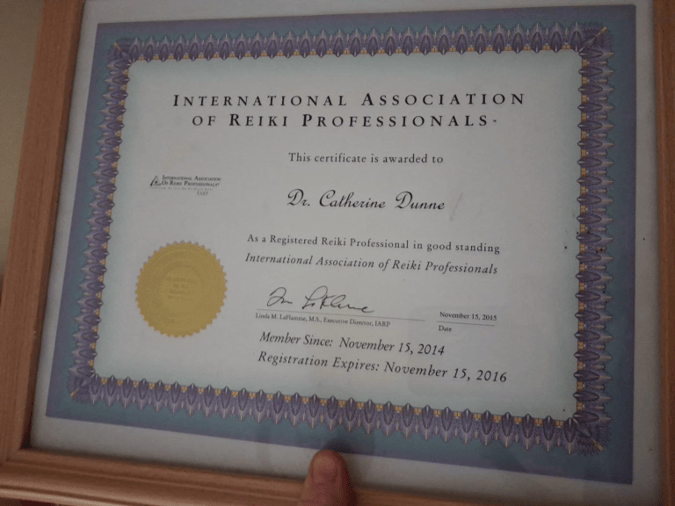
I also became a registered member of the International Association of Reiki Professionals in November 2014.
The documentation fulfilled an administrative and professional purpose.
It was not the beginning of my Reiki journey.
That distinction has always mattered to me.
Certificates can document particular training and registration milestones. They cannot necessarily tell the whole story of how, when or from whom a person first learnt a practice.
The Reiki Grandmaster Series: Why Stop at Eighteen?
Over time, my studies extended into the Reiki Grandmaster Series.
For many years, the extended series I knew comprised eighteen levels.
It is important to distinguish these later Grandmaster teachings from the traditional Reiki Ryoho system associated with Mikao Usui. The extended levels were developed by subsequent practitioners and represent later interpretations and additions, rather than teachings documented as originating with Usui himself.
As I studied and practised, I found myself reflecting on an important question.
If the Grandmaster Series had developed through the experiences and contributions of practitioners, why should its development necessarily end at Level 18?
What made eighteen the final number?
For me, spiritual learning had never been a matter of reaching a particular rank and declaring the journey complete.
Experience continues. Understanding deepens. New perspectives emerge.
And sometimes, those experiences inspire us to share something with others.
Ho’oponopono: The Inspiration Behind Levels 19 and 20
One of the practices that profoundly influenced my thinking was Ho’oponopono.
Through studying its teachings on forgiveness, reconciliation, gratitude and personal reflection, I began considering how these principles might be incorporated into the extended Reiki Grandmaster tradition.
Two concepts stood out to me.
Forgiveness.
Gratitude.
Both are simple words, yet each can represent a lifetime of personal reflection.
Forgiveness does not necessarily mean forgetting what happened, excusing harmful behaviour or abandoning healthy boundaries.
For me, it concerns our relationship with what we have experienced and the possibility of no longer allowing past events to dominate our inner lives.
Gratitude, meanwhile, encourages us to recognise what has been received, what has been learnt and what continues to hold meaning.
Although gratitude already has a place within traditional Reiki philosophy, I wanted to explore these two principles more explicitly within the extended Grandmaster teachings.
And so I developed two additional levels.
Level 19 — Dai Yosha: The Great Forgiveness
I dedicated Level 19 to forgiveness.
Its purpose within my teaching was to encourage reflection on the emotional and spiritual significance of forgiveness, both towards others and towards ourselves.
Level 20 — Dai Kansha: The Great Gratitude
I dedicated Level 20 to gratitude.
For me, gratitude represented a fitting continuation of the journey: an opportunity to acknowledge our experiences, the people who have taught us, and the lessons we carry forward.
These levels were my own contribution to the modern Reiki Grandmaster Series, inspired by my personal experiences and my study of Ho’oponopono.
I was not claiming to add to Mikao Usui’s original teachings.
I was sharing something that had become meaningful within my own spiritual practice.
Not Everyone Agreed!
When I first introduced the idea of Levels 19 and 20, it was not universally welcomed.
I remember a conversation with fellow Reiki practitioner Jay Burrell.
Jay initially challenged the idea that someone could simply add further levels to the existing Grandmaster Series.
My response was straightforward:
Why not? How did the first eighteen levels come about?
My point was not that anyone should claim historical authority for newly developed teachings.
Rather, I believed that if the extended series had evolved through the experiences of practitioners, there was no obvious reason why that process had to stop at eighteen.
Interestingly, Jay subsequently became one of the first practitioners I personally initiated into Levels 19 and 20.
Looking back, I can smile about that exchange.
Sometimes a difference of opinion becomes the beginning of a worthwhile conversation.
And sometimes the person who initially questions an idea becomes one of the first to experience it!
Documenting My Contribution
On 8 February 2017, I registered my original work, Reiki Levels 19 & 20 Grandmaster Series, with the UK Copyright Service.
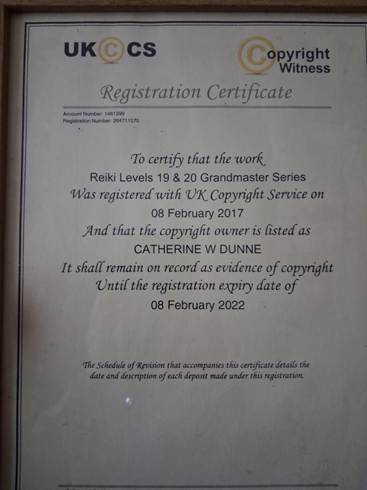
The registration listed me, Catherine W. Dunne, as the copyright owner.
For me, this was an important step in documenting the teaching material I had developed.
The certificate provides a dated record of the deposited work. It should not be confused with a government grant of copyright or with recognition that the material forms part of traditional Usui Reiki.
Over the years, I have seen references to Levels 19 and 20 appear within the wider Reiki community, sometimes with my name acknowledged as their creator.
It is an unusual feeling to encounter something that began as a personal revelation and discover that others have incorporated it into their own learning.
But perhaps that is part of what teaching is about.
We share what we have learnt, and others decide what meaning it holds for them.
More Than a Collection of Certificates
Over the decades, my treatment room has gradually filled with certificates, books, Japanese Reiki symbols, anatomical charts and reminders of the many subjects I have studied.
Some certificates remain on display. Others are rotated because there simply is not enough wall space!
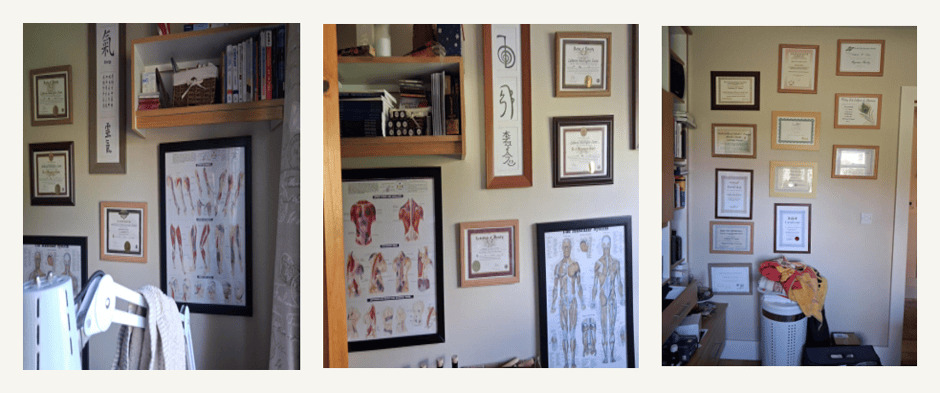
Yet when I look back over my Reiki journey, the certificates are not what I remember most.
I remember the knowledge passed on by my stepfather.
I remember recognising familiar teachings when I encountered Reiki practitioners in Dublin.
I remember discovering more about Japanese Reiki traditions.
I remember the questions, conversations, occasional disagreements and wonderful people I have met along the way.
And I remember the moment I realised that forgiveness and gratitude deserved a particular place within the Grandmaster teaching framework I had come to know.
My professional background in nursing has also taught me the importance of distinguishing personal spiritual experience from established medical knowledge.
Reiki is a complementary practice, not a substitute for medical assessment or treatment. My reflections here concern its personal, philosophical and spiritual significance rather than claims of medically proven effects.
For me, these different areas of learning have encouraged a continuing curiosity about the human experience.
Beyond Reiki: The Evolution of My Healing Practice
As the years passed, my journey did not remain confined to Reiki.
My curiosity led me to explore and study numerous other approaches to energy healing and holistic wellbeing, including Daoist energy practices, chakra healing, crystal therapy, colour and sound vibrational therapies, acupressure, dowsing, Ho’oponopono and other complementary modalities.
Each offered a different perspective, a different understanding and another opportunity to broaden my experience.
Over time, I came to realise that I no longer regarded myself exclusively as a Reiki practitioner.
Today, I describe myself as an Energy Practitioner Therapist.
Rather than working within the boundaries of one particular healing system, I draw upon the knowledge, techniques and experiences I have accumulated over the years.
No two clients are alike. Their circumstances, preferences and reasons for seeking support differ, and so does my approach.
Sometimes Reiki may form part of a session. At other times, I may incorporate elements of other complementary practices, depending upon what feels appropriate for the individual at that particular moment.
I do not believe that every person requires the same approach simply because they have booked the same type of appointment.
For me, holistic practice has always been about recognising the individual rather than following a rigid formula.
My nursing background has also reinforced the importance of listening, observation, professional judgement and understanding the limits of complementary therapies.
And perhaps that is one of the greatest lessons my journey has taught me.
I do not need to choose between the different traditions I have studied. I can appreciate what each has contributed to my understanding while remaining mindful of the needs, choices and wellbeing of the person in front of me.
Reiki will always hold a special place in my life, particularly because of the family connection through which I first encountered it.
But today, it is one part of a much broader journey.
And that journey continues.
Final Reflections: The Journey Does Not End at a Number
When I introduced Levels 19 and 20, I was not seeking another title or a higher rank.
I was responding to something I had learnt.
The Grandmaster Series had long contained eighteen levels, but I did not believe that personal understanding must end simply because a teaching system had reached a particular number.
Forgiveness and gratitude had become meaningful principles within my own journey, and I wanted to share them.
Whether others choose to incorporate those teachings into their practice is entirely their decision.
What matters to me is the intention behind their creation.
After all these years, I continue to believe that learning should remain an open door.
We can respect tradition while recognising the difference between historical teachings and later personal contributions.
We can acknowledge our teachers while continuing to develop our own understanding.
And perhaps, above all, we can remember that no certificate, title or number can fully describe the experiences that shape a person’s journey.
My Reiki story began with knowledge passed from one generation to another.
My contribution of Levels 19 and 20 was simply another chapter in that continuing story.
And if I were to leave readers with two thoughts from that chapter, they would be these:
May we find the wisdom to forgive.
And may we never forget the importance of gratitude.
Catherine
CWD | 23 Oct 2026 | Ireland
Dr Catherine W. Dunne
Holistic Healthcare Wexford
Integrative · Mindful · Patient-Centred
Co-Founder, Aumvedas Academy
Creator of Reiki Grandmaster Levels 19 and 20
Author’s note: This article is a personal account of my experiences and contributions to the extended Reiki Grandmaster tradition. Historical family recollections are presented as they were passed down to me. The extended Grandmaster levels should not be confused with the original teachings of Mikao Usui.
About the Author
Dr Catherine W. Dunne, MSc.D., RGN, is a Registered General Nurse with over 38 years of clinical experience and an extensive background in complementary and holistic healthcare. She is the founder of Holistic Healthcare Wexford and co-founder of Aumvedas Academy.
Her journey with Reiki began through family teachings, long before formal training and professional registration became central features of Western Reiki practice. Over the decades, she has studied and practised numerous energy healing traditions, including traditional Japanese Reiki techniques, Daoist energy practices, chakra therapy, dowsing and Ho’oponopono.
In 2017, Catherine formally documented her original contribution to the extended Reiki Grandmaster Series: Level 19, Dai Yosha (The Great Forgiveness), and Level 20, Dai Kansha (The Great Gratitude).
Today, she describes herself as an Energy Practitioner Therapist, drawing upon her knowledge of different complementary modalities to provide an individualised approach to holistic wellbeing.
Based in County Wexford, Ireland, Catherine continues to combine her clinical nursing background with her lifelong interest in holistic education, personal development and energy healing.
Disclaimer
This article is a personal and historical reflection on the author’s Reiki journey, experiences and contributions to the extended Reiki Grandmaster Series.
Reiki and other energy healing practices are complementary approaches and are not substitutes for medical diagnosis, treatment or professional healthcare. References to energy, chakras and spiritual healing concepts reflect traditional and personal interpretations rather than established medical or scientific findings.
Readers should seek appropriate advice from qualified healthcare professionals regarding their individual health needs.
AI and Image Disclaimer
This article is based on the author’s personal experiences, recollections, original teaching materials and historical documentation.
Unless otherwise stated, the photographs of certificates, books and treatment-room interiors are from the author’s personal collection.
AI-assisted design tools have been used to create the article’s feature image and may be used to enhance visual presentation. Any AI-generated representations of historical documents are illustrative and should not be regarded as exact reproductions of the originals.
The personal history, experiences and educational perspectives presented in this article remain those of the author.