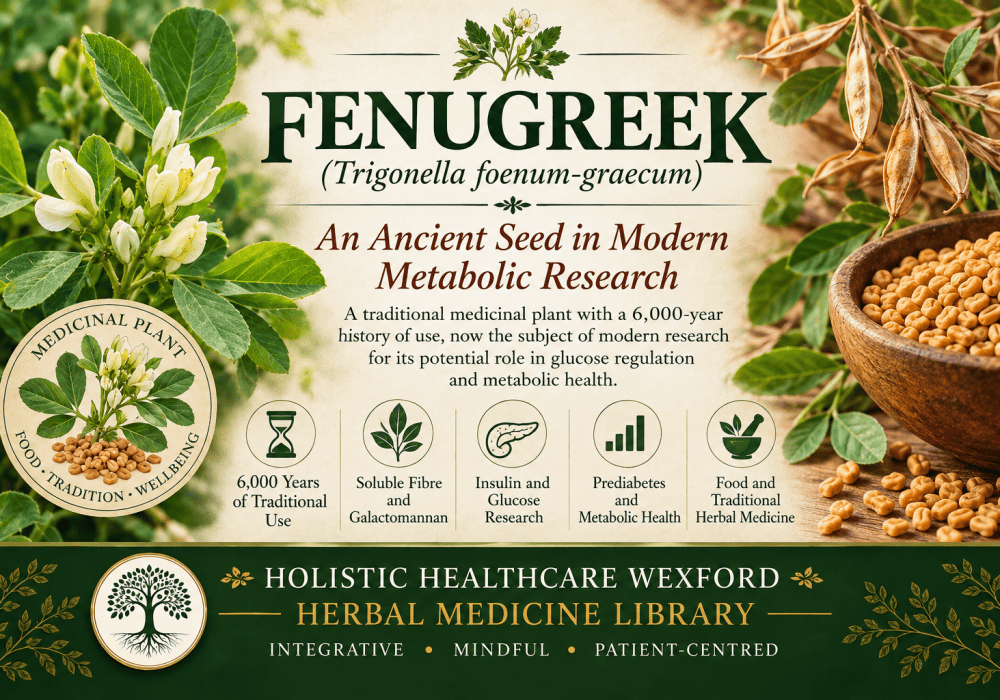
Fenugreek, Insulin and Prediabetes: Could This Ancient Seed Support Glucose Regulation?
Part of the Holistic Healthcare Wexford Herbal Medicine Library
By Dr Catherine W. Dunne, MSc.D., RGN (GPN), M.H.I.T., I.R.E.T.
Introduction
Fenugreek (Trigonella foenum-graecum) is far from being a newcomer to herbal medicine. Its medicinal use can be traced back approximately 6,000 years, making it one of the plants with a remarkably long history of human use.
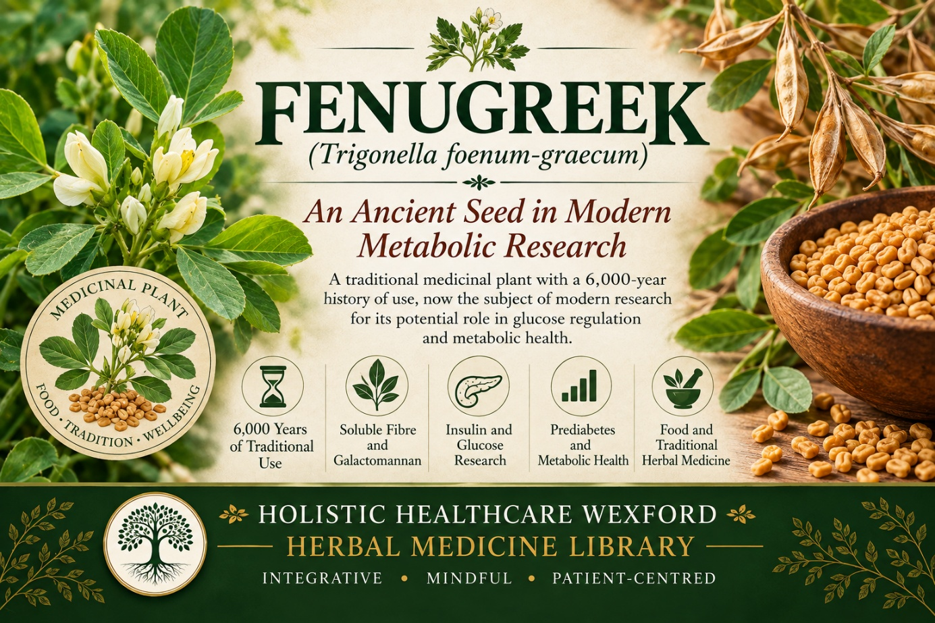
Across different cultures, fenugreek has traditionally been used as a tonic and digestive remedy, as a laxative, for menstrual discomfort and menopausal symptoms, for kidney stones and to support milk production during breastfeeding.
Not all of these traditional applications have been confirmed by modern clinical research, but they demonstrate how extensively this small aromatic seed has featured in traditional healthcare.
Today, however, fenugreek is attracting attention for a very modern problem:
deteriorating glucose regulation and the development of type 2 diabetes.
Research has investigated its effects on blood glucose, insulin secretion, post-meal glucose and other metabolic parameters.
This raises an especially interesting question:
Could fenugreek have a useful supportive role before type 2 diabetes develops?
And what about women who previously experienced gestational diabetes and consequently remain at increased risk of developing type 2 diabetes later in life?
The answer is considerably more interesting — and more nuanced — than simply saying that fenugreek “lowers blood sugar”.
Botanical Profile
Scientific name: Trigonella foenum-graecum
Family: Fabaceae
Common names: Fenugreek, Greek hay, Greek clover
Plant type: Annual leguminous herb
Part primarily used medicinally: Seed
Traditional uses: Digestive support, nourishment, metabolic support, menstrual complaints and lactation support
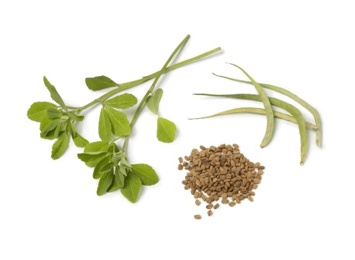
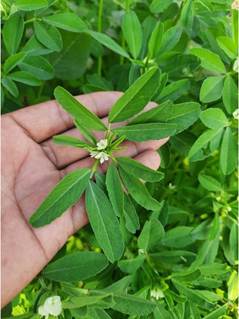
Fenugreek belongs to the same botanical family as peas, beans and clovers.
Its leaves are characteristically trifoliate, consisting of three leaflets, while its small pale flowers reveal its relationship to other members of the pea family.
For glucose metabolism, most research has concentrated on the seed.
Fenugreek seeds contain several potentially important constituents, including:
- soluble fibre and mucilage
- galactomannan
- saponins
- polyphenols
- trigonelline
- and the unusual amino-acid derivative 4-hydroxyisoleucine (4-HIL).
Rather than acting through one single pathway, these constituents may influence several different components of glucose metabolism.
First, What Does Insulin Actually Do?
When we eat carbohydrate-containing food, digestion breaks much of that carbohydrate down into glucose.
Glucose enters the bloodstream and the pancreas responds by releasing insulin.
Insulin acts rather like a metabolic key, signalling tissues – particularly muscle and adipose tissue – to take glucose from the circulation and either use it for energy or store it.
The liver is also intimately involved.
During fasting, the liver releases glucose to maintain an adequate supply for the body. Following a meal, insulin helps regulate this hepatic glucose production.
When this system works efficiently, blood glucose rises after eating and subsequently returns towards its normal range.
But with insulin resistance, tissues become less responsive to insulin.
Initially, the pancreas compensates by producing more insulin.
For some time this increased production may successfully maintain glucose levels. Eventually, however, pancreatic beta cells may no longer compensate sufficiently.
Blood glucose begins to rise.
This is one of the pathways through which prediabetes may eventually progress to type 2 diabetes.
And it is precisely this metabolic territory that makes fenugreek particularly interesting.
Fenugreek Does Not Contain Insulin
This distinction is important.
Fenugreek is not a herbal form of insulin.
Nor can it replace insulin where insulin therapy is medically required.
Instead, constituents within fenugreek appear capable of influencing several processes involved in glucose regulation.
These may include:
- carbohydrate digestion and absorption
- post-meal glucose excursions
- pancreatic insulin secretion
- glucose utilisation
- and hepatic glucose metabolism.
Understanding these mechanisms helps explain why fenugreek has attracted considerable research interest in diabetes and prediabetes.
1. Fenugreek May Slow Glucose Absorption
Fenugreek seed contains substantial amounts of soluble fibre.
When the seeds are exposed to water, this fibre absorbs fluid and produces a distinctly mucilaginous consistency.
Anyone who has soaked fenugreek seeds overnight will recognise it immediately.
Within the digestive tract, soluble fibre can influence the rate at which carbohydrate is digested and glucose absorbed.
Rather than glucose entering the circulation very rapidly after a meal, absorption may become more gradual.
In simple terms, instead of:
Meal → rapid glucose rise → substantial insulin requirement
we may see a more gradual glucose excursion after eating.
This is particularly interesting because deterioration in post-prandial glucose regulation can be an important feature of developing dysglycaemia.
And importantly, this effect is not dependent upon extracting some exotic compound from the plant.
The physical properties of the whole seed itself may be part of its therapeutic story.
2. The Fascinating 4-Hydroxyisoleucine Connection
One of fenugreek’s more unusual constituents is 4-hydroxyisoleucine, usually abbreviated to 4-HIL.
Experimental research suggests that 4-HIL can enhance insulin secretion from pancreatic beta cells.
Particularly interesting is evidence suggesting that this insulinotropic action may be glucose-dependent — becoming more relevant when glucose concentrations are elevated.
That does not mean that eating fenugreek simply forces the pancreas to continuously produce insulin.
And laboratory experiments involving isolated 4-HIL should not automatically be translated into claims about what a spoonful of fenugreek seed will accomplish in a person.
Nevertheless, it provides a biologically plausible mechanism for some of the metabolic effects being investigated clinically.
3. What About Insulin Resistance?
This is where we need to be precise.
Insulin resistance is fundamental to the development of type 2 diabetes, and several mechanisms associated with fenugreek have led researchers to investigate whether it might improve insulin sensitivity.
However, the clinical evidence is not yet sufficiently consistent to state simply that fenugreek reverses insulin resistance.
A 2023 systematic review and meta-analysis of randomised controlled trials found significant improvements in fasting blood glucose, two-hour plasma glucose and HbA1c with fenugreek, but did not find a statistically significant reduction in HOMA-IR, a commonly used marker of insulin resistance.
That distinction matters.
Fenugreek appears to influence glucose regulation.
Exactly how much of that effect results from improved insulin sensitivity, altered glucose absorption, changes in insulin secretion or other mechanisms remains an active area of research.
4. Don’t Forget the Liver
When people discuss diabetes, attention frequently centres almost entirely on the pancreas.
But the liver is a major participant in glucose regulation.
During fasting, the liver releases glucose to maintain an adequate circulating supply.
Insulin normally helps suppress unnecessary hepatic glucose production after eating.
When insulin resistance develops, this regulation can become impaired and the liver may continue contributing glucose to the circulation when it is not required.
Experimental research suggests that fenugreek constituents may influence enzymes involved in carbohydrate and hepatic glucose metabolism.
This represents another possible component of fenugreek’s overall metabolic effect.
Where Does Prediabetes Fit Into This?
This is perhaps the most interesting part of the fenugreek story.
Prediabetes is not simply “a little bit of diabetes”.
It represents a period in which glucose regulation has deteriorated but diagnostic criteria for diabetes have not yet been reached.
In Ireland, an HbA1c of 42–47 mmol/mol is generally considered within the prediabetes or high-risk range.
At this stage, metabolic abnormalities may already be present, including impaired glucose tolerance, altered post-meal glucose handling and varying degrees of insulin resistance.
But importantly:
there is still an opportunity to intervene.
Lifestyle intervention remains the foundation of diabetes prevention.
That includes appropriate nutrition, regular physical activity, weight management where relevant, good sleep, smoking cessation and management of cardiovascular risk factors.
Fenugreek should never be presented as a substitute for these measures.
However, whether fenugreek might complement them is a legitimate and increasingly interesting research question.
What Does the Research Say About Fenugreek and Prediabetes?
A particularly interesting three-year controlled study investigated fenugreek specifically in 140 men and women aged 30–70 years with prediabetes.
Participants in the intervention group received:
5 g fenugreek seed powder twice daily before meals
for a total of:
10 g per day.
Participants were monitored every three months over the three-year study.
The fenugreek group experienced a significantly lower progression to type 2 diabetes than the control group and also showed improvements in fasting and post-prandial glucose.
This is fascinating research.
But one study – even a three-year study – does not establish fenugreek as a proven preventative treatment for type 2 diabetes.
The wider evidence is encouraging but still evolving.
A 2023 systematic review and meta-analysis examining randomised controlled trials involving people with type 2 diabetes and prediabetes included 10 studies and 706 participants.
Overall, fenugreek significantly reduced:
fasting blood glucose
two-hour plasma glucose
and
HbA1c.
However, study preparations, populations and methodologies differed considerably.
The US National Center for Complementary and Integrative Health (NCCIH) therefore takes an appropriately cautious position: research suggests that fenugreek may lower blood glucose, particularly in people with type 2 diabetes, but there is still insufficient high-quality evidence to reach firm therapeutic conclusions.
That is probably the fairest interpretation of the evidence at present:
promising but not proven.
Could Fenugreek Help Prevent Prediabetes Progressing to Type 2 Diabetes?
Potentially, but we need to choose our language carefully.
The long-term prediabetes study is particularly interesting because intervention occurred before established type 2 diabetes developed.
Physiologically, that makes sense.
If post-meal glucose excursions can be moderated and overall glucose handling improved while endogenous pancreatic function remains relatively preserved, there may be an opportunity to influence the metabolic trajectory.
But fenugreek should be viewed as a possible adjunct to established diabetes-prevention strategies, not a replacement for them.
A spoonful of fenugreek does not cancel out inactivity, smoking, poor nutrition, obesity or other metabolic risk factors.
Herbal medicine works best when we look at the whole person rather than the herb in isolation.
What About Women Who Have Had Gestational Diabetes?
This is another important group — but the clinical pathway is different.
Gestational diabetes mellitus (GDM) develops during pregnancy, when profound hormonal and metabolic changes increase insulin resistance.
After delivery, pregnancy-related insulin resistance can fall dramatically.
Consequently, glucose levels frequently improve after birth.
However, experiencing GDM identifies a woman as being at increased future risk of developing type 2 diabetes.
This does not mean that every woman who has experienced GDM remains diabetic.
It means that ongoing metabolic surveillance matters.
The Irish Post-GDM Pathway
In Ireland, the early postpartum assessment following GDM takes place through the appropriate hospital/community pathway.
The HSE Diabetes in Pregnancy Model of Care recommends an oral glucose tolerance test (OGTT) 6–12 weeks following delivery, completed in the local hospital or community setting.
A negative OGTT indicates that the woman no longer has diabetes, but importantly, her future risk remains elevated.
The HSE pathway subsequently recommends:
fasting blood glucose/HbA1c at one year following birth
and thereafter:
FBG/HbA1c annual for 5 years according to individual risk factors.
This creates an important continuum between maternity services and Primary Care:
GDM during pregnancy
↓
Postpartum OGTT through hospital/community services
↓
Diabetes excluded
↓
Ongoing Primary Care surveillance
↓
Periodic FBG/HbA1c
For many women everything will remain completely normal.
For others, however, glucose regulation may gradually begin to deteriorate years later.
Previous GDM + Later Prediabetes
This is where our fenugreek discussion becomes relevant again.
Imagine a woman who experienced GDM.
Her postpartum OGTT was negative.
She subsequently returned to Primary Care follow-up.
Several years later, routine blood testing shows that her HbA1c has entered the prediabetes range.
We are no longer discussing the treatment of gestational diabetes.
We are discussing a woman with a recognised risk factor for type 2 diabetes who now also has biochemical evidence of deteriorating glucose regulation.
She has effectively entered our prediabetes conversation.
Could fenugreek have a supportive role as one component of a broader metabolic-health programme?
Potentially.
But it would sit alongside lifestyle intervention, weight management where appropriate, cardiovascular risk assessment and continued biochemical monitoring.
Her previous GDM history tells us that her metabolic trajectory deserves particular attention.
Fenugreek During Pregnancy Is Different
Nothing in this article should be interpreted as recommending therapeutic fenugreek for gestational diabetes during pregnancy.
Food quantities and medicinal quantities are not interchangeable.
Current safety guidance advises against fenugreek in quantities greater than those normally consumed as food during pregnancy.
Gestational diabetes requires appropriate obstetric and diabetes-team management.
What About Breastfeeding?
Fenugreek has a long traditional history as a galactagogue — a substance used to promote breast-milk production.
However, modern evidence for this effect is mixed.
More importantly, there remains limited information about the safety of consuming fenugreek in amounts greater than normal food quantities during breastfeeding.
Normal culinary consumption is therefore quite different from taking substantial quantities of powdered seed or concentrated extracts every day.
Recently postpartum women should not automatically begin therapeutic quantities of fenugreek simply because they previously experienced GDM.
Individual glucose status, medication, breastfeeding and the wider clinical picture should all be considered.
Fenugreek and Established Type 2 Diabetes
Fenugreek also remains interesting once type 2 diabetes has developed, but medication becomes increasingly important.
Someone with type 2 diabetes may already be taking one or several glucose-lowering medications.
Introducing therapeutic quantities of something capable of influencing glucose regulation therefore deserves appropriate monitoring.
Fenugreek should never be used as justification for independently reducing or discontinuing prescribed diabetes medication.
Fenugreek and Insulin
This deserves particular attention.
If someone using insulin begins consuming substantial therapeutic quantities of fenugreek and their glucose response changes, their established insulin regimen could potentially produce a greater glucose-lowering effect than previously.
The concern is hypoglycaemia.
That does not mean somebody using insulin can never eat fenugreek.
It means we need to distinguish between:
fenugreek used as an ordinary culinary spice
and
fenugreek consumed therapeutically every day as substantial quantities of seed, powder or concentrated extract.
The latter warrants considerably greater attention to glucose monitoring.
Food, Whole Seed and Extract Are Not the Same Thing
This principle is extremely important in herbal medicine.
A sprinkle of fenugreek used while cooking is not pharmacologically equivalent to 5 or 10 grams of seed powder taken every day.
Neither is necessarily equivalent to a commercial concentrated extract.
Whenever we discuss the potential interaction between a medicinal plant and medication, we therefore need to ask:
What preparation?
How much?
How frequently?
What medication is the person taking?
What are their glucose readings and HbA1c doing?
Without these questions, statements such as “fenugreek lowers blood sugar” tell us surprisingly little.
How Can Fenugreek Seeds Be Prepared and Consumed?
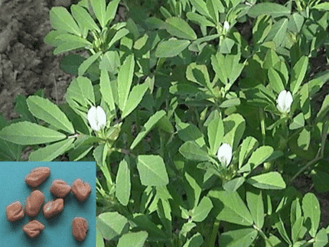
After all the discussion about glucose, insulin and clinical research, we arrive at the practical question:
What do we actually do with the seeds?
Fenugreek does not necessarily need to come from a capsule or concentrated supplement.
Whole fenugreek seed is inexpensive, stores well and can be incorporated into the diet in several simple ways.
For metabolic use, I particularly favour methods that allow us to consume the whole seed and therefore retain its naturally occurring fibre.
Soaked Fenugreek Seeds
One of the simplest methods is soaking the whole seeds overnight.
Place the seeds into a small glass or bowl and cover them generously with water.
Allow them to soak for approximately 8–12 hours.
By morning they will have softened and developed a slightly slippery or mucilaginous coating.
That is normal.
Indeed, that mucilage is one of the reasons the whole seed is so interesting.
The softened seeds can then be chewed thoroughly and eaten, preferably with or shortly before a meal.
The soaking liquid can also be consumed if desired and well tolerated.
For someone completely new to fenugreek, beginning with a smaller quantity rather than immediately consuming a substantial amount allows gastrointestinal tolerance to be established.
Ground Fenugreek Seed
Fenugreek seeds are extremely hard when dry.
They can therefore be freshly ground in a spice grinder or using a mortar and pestle.
Ground fenugreek can then be incorporated into everyday foods such as:
- porridge
- overnight oats
- natural yoghurt
- soups
- stews
- curries
- vegetable dishes
- savoury breads.
Fenugreek has a distinctive aromatic and slightly bitter flavour, so some people will find it easier to incorporate into savoury meals.
Grinding only the amount required for a short period also helps preserve the characteristic aromatic constituents of the seed.
What About 5 g Once or Twice Daily?
This is where it is important to distinguish research dosing from individual recommendations.
The three-year prediabetes study discussed earlier used:
5 g of fenugreek seed powder twice daily before meals — 10 g per day in total.
That was the study protocol.
It should not be interpreted as a universal dose for everybody with prediabetes.
For someone introducing fenugreek as a food-based adjunct, a more cautious approach may be to begin with a smaller quantity and establish gastrointestinal tolerance first.
For example, up to approximately 5 g once daily may be introduced initially before considering larger quantities.
If well tolerated, the research protocol provides useful context for why 5 g twice daily is sometimes discussed in relation to prediabetes.
However, individual circumstances matter.
Fenugreek’s substantial fibre content means that suddenly consuming large quantities may result in bloating, wind, diarrhoea or other gastrointestinal discomfort.
And anyone taking glucose-lowering medication — particularly insulin or medicines capable of producing hypoglycaemia — should not simply introduce therapeutic quantities without appropriate clinical consideration and glucose monitoring.
What About Fenugreek Tea?
Fenugreek seeds can certainly be infused or gently decocted in water.
This remains a traditional and perfectly reasonable way of consuming fenugreek.
However, when my particular interest is prediabetes and glucose regulation, I favour actually consuming the whole or ground seed.
Why?
Because the fibre itself appears to be part of the story.
If we prepare a tea and subsequently discard the seeds, we are not consuming all of the fibre naturally present within them.
For this particular purpose, the simplest preparation may therefore also be one of the most logical:
eat the seed.
What About a Fenugreek Tincture?
Fenugreek can also be prepared as an alcohol-based herbal extract.
However, once again, a tincture and a whole seed preparation are not physiologically identical.
Alcohol can extract many plant constituents very effectively.
What it cannot reproduce is the physical effect of consuming several grams of soluble dietary fibre.
Therefore, although a fenugreek tincture may have applications within herbal practice, it would not be my first choice when the specific objective is the metabolic application discussed in this article.
For that purpose, I prefer the whole seed.
A Simple Practical Approach
For an adult wishing to incorporate fenugreek seed into an otherwise healthy diet, the principle is straightforward:
Start low → establish tolerance → consume regularly → preferably take with or shortly before a meal.
Whole seeds can be soaked overnight.
Alternatively, they can be freshly ground and incorporated into food.
Research involving people with prediabetes has used 5 g twice daily before meals, but that remains a research protocol rather than a universal prescription.
And remember that fenugreek should complement the foundations of metabolic health — nutritious food, regular physical activity, appropriate weight management, adequate sleep and appropriate clinical surveillance — rather than being expected to compensate for their absence.
Catherine’s Herbal Notes
Harvest season: Fenugreek seed is harvested once the seed pods have matured and dried.
Parts used: Primarily the seeds when considering metabolic applications.
Favourite preparation: For the particular purpose of supporting glucose regulation, I favour the whole seed — soaked overnight or freshly ground and incorporated into food. This retains the soluble fibre naturally present within the seed.
Growing location: Although fenugreek can be grown as an annual herb in Ireland, good-quality dried seeds are readily available and, for my own purposes, I am quite content to buy the seeds rather than surrender another corner of my medicinal herb garden to an enthusiastic annual!
Personal observation: Soaking fenugreek makes its mucilaginous nature immediately apparent. To me, this is an excellent reminder that medicinal plants do not work exclusively through isolated chemical constituents. Sometimes the physical characteristics of the whole plant material — in this case its fibre — are themselves part of the therapeutic picture.
From a clinical perspective, I find fenugreek particularly interesting in the earlier metabolic window: the patient whose HbA1c is beginning to rise, someone with established prediabetes, or a woman with previous GDM whose later Primary Care surveillance begins to demonstrate deteriorating glucose regulation.
These are precisely the situations in which prevention deserves our attention.
Final Thoughts
Fenugreek is not insulin.
It is not a cure for diabetes.
And it should never be presented as an alternative to appropriate diabetes care.
But neither should a medicinal seed with approximately 6,000 years of traditional use, biologically plausible mechanisms and an expanding body of clinical research simply be dismissed.
Fenugreek appears capable of influencing several components of glucose regulation.
Clinical research has reported effects on fasting glucose, post-prandial glucose and HbA1c, while laboratory research continues to investigate mechanisms involving carbohydrate absorption, insulin secretion and glucose metabolism.
That makes its possible role in prediabetes particularly interesting.
Prediabetes gives us something enormously valuable:
time to intervene.
Likewise, a history of gestational diabetes provides an opportunity for continued surveillance and early intervention should glucose regulation begin deteriorating later in life.
The sensible question therefore isn’t:
“Can fenugreek replace diabetes medication?”
It cannot.
A much more useful question is:
“Could fenugreek, appropriately used and monitored, form one small part of a broader strategy aimed at supporting metabolic health before type 2 diabetes becomes established?”
Current research suggests that question deserves further investigation.
And that is exactly where good integrative healthcare belongs … bringing together traditional knowledge, modern research, clinical monitoring and common sense.
I hope this has inspired you to look a little more closely at the humble fenugreek seed — not simply as a familiar culinary spice, but as a medicinal plant with thousands of years of traditional use and an increasingly interesting place in modern metabolic research.
Herbal medicine continually reminds us that some of the most fascinating plants do not need to be rare or exotic. Sometimes they are sitting quietly in our kitchen cupboards, waiting for us to understand them a little better.
Look after your body, and it will help look after you.
Catherine

CWD | 02 Oct 2026 | Ireland
Holistic Healthcare Wexford
Integrative · Mindful · Patient-Centred
References & Further Reading
- Gaddam A, Galla C, Thummisetti S, et al. Role of fenugreek in the prevention of type 2 diabetes mellitus in prediabetes. Journal of Diabetes & Metabolic Disorders. 2015;14:74.
View study — PubMed - Kim J, Noh W, Kim A, Choi Y, Kim Y-S. The effect of fenugreek in type 2 diabetes and prediabetes: a systematic review and meta-analysis of randomized controlled trials. International Journal of Molecular Sciences. 2023;24(18):13999.
Read full paper — PubMed Central - Sauvaire Y, Petit P, Broca C, et al. 4-Hydroxyisoleucine: a novel amino acid potentiator of insulin secretion. Diabetes. 1998;47(2):206–210.
View paper — Diabetes - Broca C, Gross R, Petit P, et al. 4-Hydroxyisoleucine: experimental evidence of its insulinotropic and antidiabetic properties. American Journal of Physiology – Endocrinology and Metabolism. 1999;277(4):E617–E623.
View paper — American Physiological Society - National Center for Complementary and Integrative Health. Fenugreek: Usefulness and Safety. National Institutes of Health.
NCCIH — Fenugreek - National Library of Medicine. Fenugreek. Drugs and Lactation Database (LactMed®).
LactMed — Fenugreek - Health Service Executive. Diabetes in Pregnancy: A Model of Care for Ireland. National Clinical Programme for Diabetes.
HSE — Diabetes in Pregnancy Model of Care
Important Safety Information
This article is provided for educational purposes and does not replace individual medical advice.
Fenugreek is generally considered safe when consumed in normal food quantities, but larger quantities can cause gastrointestinal symptoms and may produce excessive lowering of blood glucose in some circumstances.
People taking insulin or other glucose-lowering medication should discuss therapeutic fenugreek supplementation with an appropriately qualified healthcare professional and monitor glucose appropriately.
Fenugreek in quantities greater than those normally found in food should not be used during pregnancy.
Safety information regarding therapeutic quantities during breastfeeding remains limited.
Anyone with an allergy to fenugreek or potentially related legumes should exercise appropriate caution.
Prescribed diabetes medication, including insulin, should never be stopped or independently adjusted because fenugreek or another herbal preparation has been introduced.
About the Author
Dr Catherine W. Dunne MSc.D. is a Registered General Nurse with over 37 years of clinical experience in primary care in Ireland. Alongside her work in General Practice Nursing, she is the founder of Holistic Healthcare Wexford and co-founder of Aumvedas Academy.
With a background that bridges conventional medicine and holistic practice, Catherine has a particular interest in the area where patients are often told “everything is normal,” yet still feel unwell. Her work focuses on helping people understand what their body is communicating, especially in relation to energy, stress, metabolic function, and recovery.
Through a combination of clinical knowledge and holistic support, she works with individuals to restore balance, improve resilience, and support long-term wellbeing.
Based in Wexford, Ireland.
Disclaimer
This article is for informational and educational purposes only and is not intended as medical advice. It does not replace consultation with a qualified healthcare professional. Patients should always seek appropriate medical guidance regarding their individual health needs and before making changes to treatment or care.
AI-Disclaimer:
About the images: Unless otherwise stated, the photographs used throughout this library are the author’s own. AI-assisted design tools may be used to create educational layouts, improve presentation, and incorporate Holistic Healthcare Wexford branding. The botanical content and educational purpose remain those of the author.

